Canada Post Xpresspost1–2 day delivery across CanadaFree on orders over $200

Reference

The Peptide Research Glossary, A to Z

Every term that actually appears on a certificate, a product page or in the literature, defined in plain language, with links where a term has its own guide

·By Adam Reeves · Research Editor, Eppix Labs

Most of the vocabulary in this market is borrowed from analytical chemistry, pharmacology and regulatory practice, and none of those fields explains itself on a product page. This is the short version of all three, arranged alphabetically.

Where a term has a full guide behind it, the definition links to it. Everything defined here concerns laboratory research materials; nothing here is guidance for human or veterinary use.

A to C

  • ·Agonist. A compound that activates a receptor, as opposed to an antagonist, which blocks it. Most metabolic peptides in this catalogue are receptor agonists.
  • ·Amidation (-NH2). A C-terminal modification that improves stability and changes the molecular weight, which is how mass spectrometry distinguishes an amidated variant. See understanding peptide sequences.
  • ·Amino acid. The building block of a peptide. Twenty standard residues, plus synthetic ones such as Aib and 2-Nal used in engineered sequences.
  • ·Analog (analogue). A modified version of a natural peptide, engineered for stability or kinetics. Semaglutide is a GLP-1 analogue.
  • ·Bacteriostatic water. Sterile water containing 0.9% benzyl alcohol, the standard vehicle for multi-entry reconstitution. Full guide: bacteriostatic water.
  • ·Batch / lot. One production run. All meaningful verification is lot-level: the lot code links vial to certificate to laboratory database.
  • ·CAS number. A compound's unique chemical registry identifier, used to look up true specifications in public databases.
  • ·Certificate of analysis (COA). The laboratory report for one lot: identity, purity, measured content. See how to verify a peptide COA.
  • ·Chromatogram. The output graph of an HPLC run. The purity number is the target peak's share of total peak area. See what is HPLC testing.
D to H

  • ·DAC (drug affinity complex). An albumin-binding modification that extends circulating half-life from hours to days. The clearest case is CJC-1295 with DAC vs without.
  • ·D-amino acid. The mirror-image form of a residue. Proteases handle it poorly, so D-residues are a deliberate stability tool.
  • ·Deletion sequence. A synthesis error: the target chain minus one residue. The characteristic impurity that purification removes. See how peptides are made.
  • ·Fill accuracy. Measured milligrams against the label claim. The number a short fill depends on you never seeing. See purity vs fill accuracy and underfilled vials.
  • ·GHRH. Growth-hormone-releasing hormone, the axis entered by sermorelin, tesamorelin and the CJC-1295 family.
  • ·GHS / secretagogue. Ghrelin-receptor compounds that stimulate growth-hormone release, ipamorelin being the selective example. Prohibited in tested sport.
  • ·GLP-1 / GIP. Incretin hormones, and the receptor targets of semaglutide (GLP-1), tirzepatide (both) and retatrutide (both plus glucagon).
  • ·Half-life. The time for a circulating concentration to halve. The property most engineering modifications are aimed at.
  • ·HPLC. High-performance liquid chromatography, the standard purity method. Full explainer: what is HPLC testing.
  • ·Hygroscopic. Moisture-absorbing, which is why lyophilised vials stay sealed until use and why a cold vial should be brought to room temperature before opening.

I to P

  • ·In vitro / in vivo. In cell culture, and in a living organism. Research-market peptides are supplied for in-vitro laboratory work.
  • ·Janoshik Analytical. The independent laboratory that tests every lot in this catalogue, with certificates verifiable on its own public database. See Janoshik testing explained.
  • ·Lyophilised. Freeze-dried. The stable powder form peptides ship in.
  • ·Mass spectrometry (MS). The identity and content method: measures mass and compares it against the sequence's theoretical value. See mass spectrometry in peptide verification.
  • ·Molecular weight / molar mass. The sequence-determined mass that anchors identity testing. See peptide molecular weight.
  • ·Peptide. A chain of amino acids shorter than a protein. This catalogue spans three residues (KPV) to more than forty (tesamorelin).
  • ·Pulsatility. Release in pulses rather than continuously. The central design variable in growth-hormone-axis research.
  • ·Purity. The proportion of peptide content that is the target compound. The research-grade convention is 99% or better.

R to Z

  • ·Receptor selectivity. Activating the intended receptor with minimal off-target signal. Ipamorelin's defining published property.
  • ·Reconstitution. Dissolving lyophilised powder into solution. Technique: the reconstitution guide. Arithmetic: the calculator.
  • ·Research use only (RUO). The regulatory category: supplied for laboratory research, not authorised for human or veterinary use. See are peptides legal in Canada.
  • ·Salt form. Peptides commonly ship as acetate salts; the counterion adds mass, which is why a certificate should say whether its figures are net peptide.
  • ·Sequence. A peptide's ordered residues, written N to C in one- or three-letter code. See understanding peptide sequences.
  • ·SPPS. Solid-phase peptide synthesis, how research peptides are built. See how peptides are made.
  • ·Verification key. The unique identifier on a certificate that resolves on the testing laboratory's own site. The feature that makes forging the document pointless.
  • ·WADA / CCES. The world and Canadian anti-doping bodies. Many research peptides appear on their prohibited lists, which is a system entirely separate from Canadian law. See peptides and anti-doping.
  • ·x-mer (15-mer, 44-mer). Shorthand for a peptide's residue count.

The terms as they appear on a real certificate

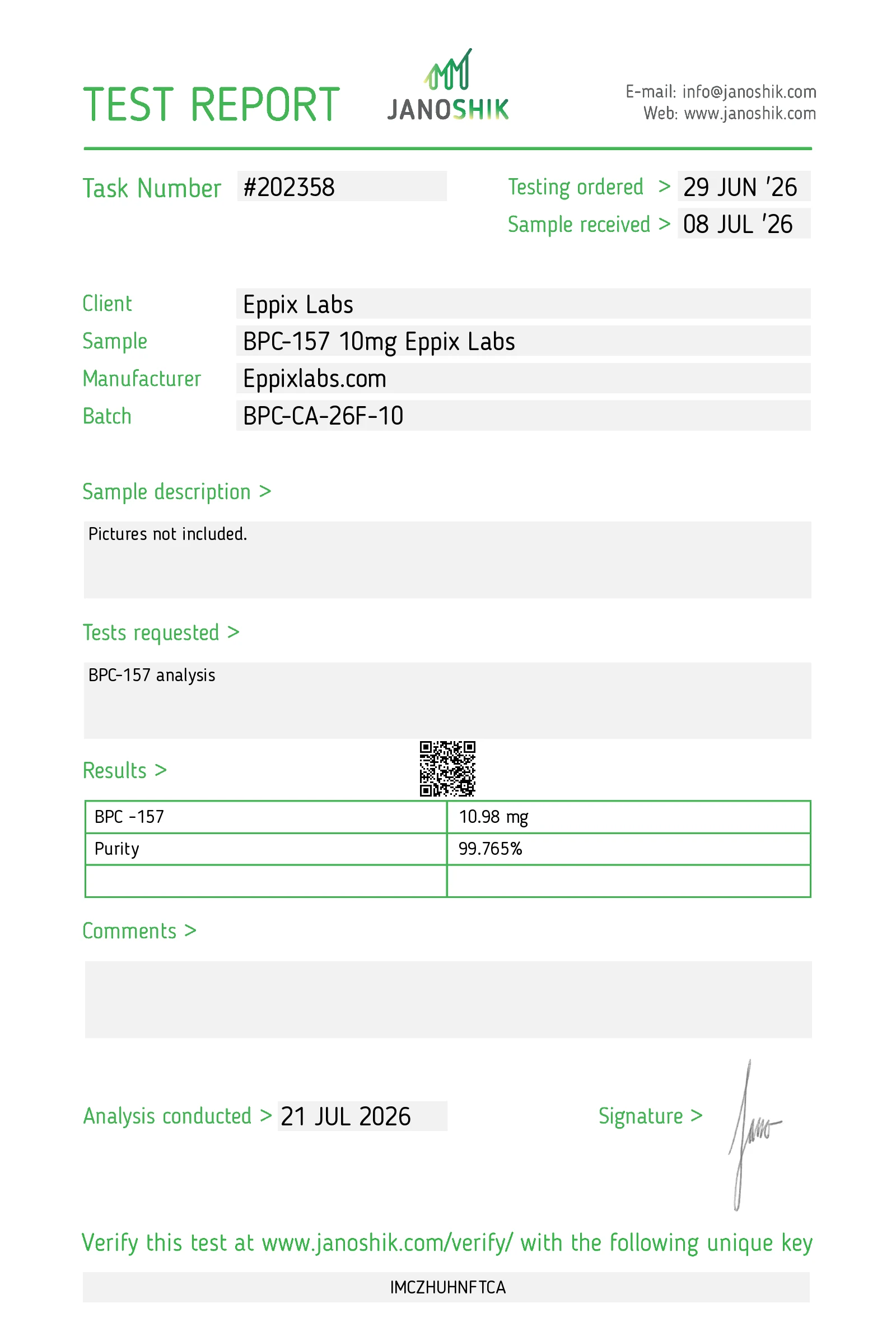
Most of the vocabulary above converges on one document. A lot certificate carries the lot code, the testing laboratory, an HPLC purity figure, a mass-spectrometric identity result against a theoretical mass, a measured content figure against the labelled amount, and a verification key.

If a term on this page is unfamiliar, the fastest way to fix that is to open a certificate and find it.

Published Certificate
Certificate of analysis for Buy BPC-157 Canada | 10mg & 20mg Vials 10mg, batch BPC-CA-26F-10, 99.765% purity, 10.98 mg measured content

Select strength

Batch
BPC-CA-26F-10
Purity (HPLC)
99.765%
Measured content
10.98 mglabelled 10 mg
Laboratory
Janoshik
A current published certificate, where most of the glossary appears in one page.

Frequently Asked

What is the single most important term here?

Lot. Every quality claim with any content in this market is a claim about one specific production run, verified or not. A product-level claim is a statement of intent.

What does "research use only" actually mean?

That the material is supplied for laboratory research and is not authorised for human or veterinary use. It is the legal structure of the whole market rather than a disclaimer appended to it.

What is the difference between purity and content?

Purity is a ratio: what fraction of the peptide present is the target compound. Content is an amount: how many milligrams are in the vial. A vial can score perfectly on the first and badly on the second.

Where do I go deeper on a term?

Each linked guide above covers one term in full, and the research index lists everything published.

References

  1. Behrendt, R., White, P., Offer, J. (2016). Advances in Fmoc solid-phase peptide synthesis. J Pept Sci 22(1):4-27. PMID 26785684
  2. Aebersold, R., Mann, M. (2003). Mass spectrometry-based proteomics. Nature 422(6928):198-207. PMID 12634793
  3. World Anti-Doping Agency (2026). The Prohibited List: international standard, updated annually. WADA. Source

Research Use Only

This article summarizes published preclinical research literature. Compounds referenced are supplied by Eppix Labs strictly as research materials for laboratory investigation within Canada. They are not approved by Health Canada for human or veterinary use, and nothing on this page should be interpreted as medical advice or guidance on human or animal administration.