Canada Post Xpress1–2 day delivery across CanadaFree on orders over $200

Laboratory Practice

Peptide Reconstitution: The Laboratory Guide

Solvent choice, the arithmetic, and the handling errors that destroy material before an experiment starts

·Compiled by Eppix Labs

Reconstitution is where more research material is lost than at any other point in handling, and almost all of it to avoidable causes: the wrong solvent for the peptide's charge, a vacuum-driven solvent stream fired directly onto the cake, or agitation vigorous enough to denature what it was meant to dissolve.

This is a laboratory-practice reference. It describes general laboratory methods for handling research materials and contains no dosing, administration or human-use guidance of any kind.

Before opening anything

  • ·Let the vial reach room temperature. Opening a vial straight from a freezer draws humid air onto cold glass, and the condensate goes into the cake. Twenty to thirty minutes on the bench costs nothing.
  • ·Read the measured content, not the label. The certificate reports what is actually in the vial. If the label says 10 mg and the certificate reports 11.4 mg, your concentration arithmetic should use 11.4.
  • ·Inspect the cake. A lyophilized peptide should be a white to off-white solid or a thin film. Yellowing, oiliness or partial liquefaction indicates a temperature or moisture excursion in transit or storage.
  • ·Check the vacuum. Most lyophilized vials are sealed under partial vacuum. A vial that does not draw solvent at all may have lost its seal.
Choosing a solvent by peptide chemistry

Solubility follows net charge, and net charge follows the residues in the sequence. This is the single most useful thing to know about reconstitution, and it explains most apparent quality problems.

  • ·Basic peptides (net positive: excess Lys, Arg, His) generally dissolve in water or slightly acidic aqueous solution.
  • ·Acidic peptides (net negative: excess Asp, Glu) dissolve poorly in water at low pH and readily in slightly basic solution. Epitalon, two of whose four residues are acidic, is the clearest example in the catalogue.
  • ·Neutral or hydrophobic peptides may need a small volume of an organic co-solvent to wet the cake before aqueous dilution.
  • ·Sterile or bacteriostatic water is the standard aqueous choice in most laboratory protocols. Bacteriostatic water contains benzyl alcohol as a preservative and is used where a solution will be held rather than consumed at once.
  • ·Acetate salts dissolve more readily than the corresponding free acids for the same sequence, which is why most research peptides are supplied as acetates.

Technique

Three rules, all of them about not applying force to a fragile solid.

  • ·Direct the stream at the glass, not the cake. Angle the needle so solvent runs down the vial wall. A vacuum-assisted stream fired straight onto a lyophilized cake atomizes it, and material ends up on the stopper rather than in solution.
  • ·Add slowly and let the vacuum do the work. The partial vacuum will draw solvent in on its own. Forcing it in faster achieves nothing except foaming.
  • ·Swirl, do not shake. Gentle rotation for thirty seconds, then rest. Vigorous agitation shears peptide chains and generates foam, and foam is denatured material at an air-liquid interface. Aggregation-prone peptides such as the amylin analogues are least tolerant of this.
  • ·Give it time. Some peptides take several minutes to go fully into solution. Apparent insolubility after ten seconds is usually impatience.

The arithmetic

Concentration is measured content divided by solvent volume. Working from the label rather than from the measured figure introduces an error equal to the fill overage, which is commonly five to fifteen percent and occasionally much larger.

Worked example: a vial whose certificate reports 11.4 mg of measured content, reconstituted with 2 mL of solvent, gives 11.4 / 2 = 5.7 mg/mL. Using the 10 mg label instead would have given 5.0 mg/mL, a 12% error carried into every downstream calculation.

The site peptide calculator does this arithmetic, and the reason measured content is published on every certificate is so that it can be done correctly.

Published Certificate
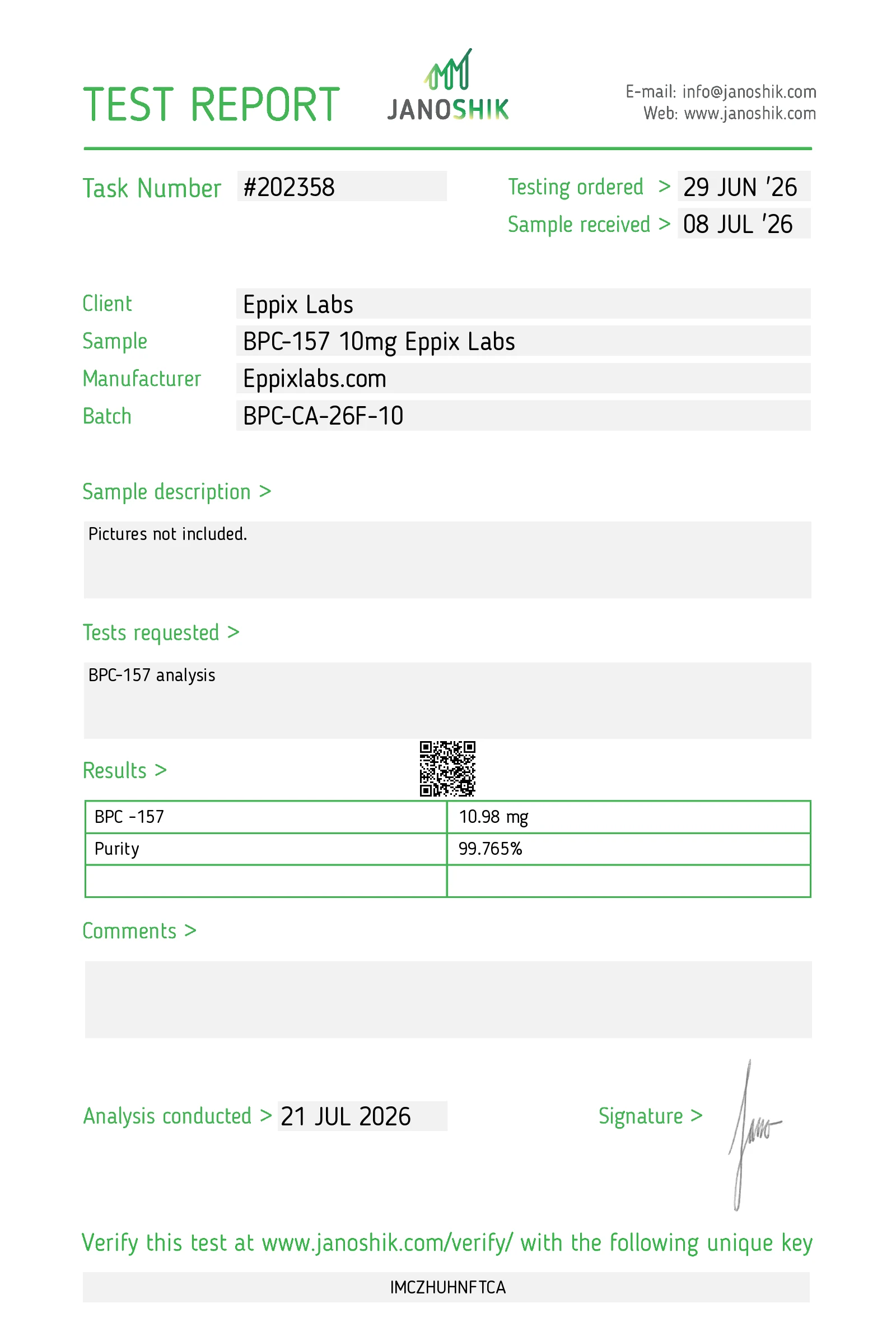
Certificate of analysis for Buy BPC-157 Canada | 10mg & 20mg Vials 10mg, batch BPC-CA-26F-10, 99.765% purity, 10.98 mg measured content

Select strength

Batch
BPC-CA-26F-10
Purity (HPLC)
99.765%
Measured content
10.98 mglabelled 10 mg
Laboratory
Janoshik
Measured content, the figure the concentration arithmetic should use, alongside the labelled amount.

When it does not dissolve

  • ·Cloudy or hazy solution. Usually a pH mismatch for the peptide's charge rather than contamination. Check the sequence for acidic or basic residue excess and adjust the solvent accordingly.
  • ·Visible particulate that will not clear. Possible aggregation, which is more likely in material that has been through a temperature excursion or repeated freeze-thaw. Aggregation-prone classes include amylin analogues and long lipidated peptides.
  • ·Foam that does not settle. Agitation was too vigorous. Let it stand; the foam layer represents lost material rather than recoverable material.
  • ·Nothing dissolves at all. Confirm the vial is the compound you think it is. This is rare, and it is the point at which the identity line on the certificate earns its place.

After reconstitution

Reconstituted peptides are far less stable than lyophilized ones: hydrolysis, oxidation and deamidation all proceed in solution and effectively stop in a dry solid.[1][2] Refrigerate at 2 to 8 °C, protect from light, and use within the window your protocol defines.

Aliquot rather than freeze-thawing a single vial repeatedly. Each cycle costs material, and the loss is cumulative rather than one-off. Storage detail is in the peptide storage guide.

Frequently Asked

What solvent should I use?

It depends on the peptide's net charge. Basic sequences dissolve in water or mildly acidic solution; acidic sequences need a slightly basic solution; hydrophobic sequences may need an organic co-solvent to wet the cake first. Sterile or bacteriostatic water is the standard aqueous choice in laboratory protocols.

Why is my peptide not dissolving?

Most often a pH mismatch for the sequence's charge rather than a quality problem. Acidic peptides in plain water are the classic case. Give it time as well: some peptides take several minutes.

Should I shake the vial?

No. Swirl gently. Vigorous agitation shears chains and creates foam, and foam is denatured material at an air-liquid interface. Aggregation-prone peptides are least tolerant of it.

Should I calculate from the label or the certificate?

From the measured content on the certificate. Fill overage is commonly five to fifteen percent, and using the label carries that error into every downstream figure.

What is bacteriostatic water?

Sterile water containing benzyl alcohol as a preservative, used in laboratory protocols where a solution is to be held rather than used immediately. Plain sterile water has no preservative.

How long does reconstituted material last?

Far less long than lyophilized material, because hydrolysis, oxidation and deamidation proceed in solution. Refrigerated, protected from light, and used within the window your protocol defines.

References

  1. DeHart, M.P., Anderson, B.D. (2012). Effects of water and polymer content on covalent amide-linked adduct formation in peptide-containing amorphous lyophiles. J Pharm Sci 101(9):3096-3109. PMID 22437444
  2. Li, B. et al. (2005). Effects of sucrose and mannitol on asparagine deamidation rates of model peptides in solution and in the solid state. J Pharm Sci 94(8):1723-1735. PMID 15986465

Research Use Only

This article summarizes published preclinical research literature. Compounds referenced are supplied by Eppix Labs strictly as research materials for laboratory investigation within Canada. They are not approved by Health Canada for human or veterinary use, and nothing on this page should be interpreted as medical advice or guidance on human or animal administration.