Canada Post Xpress1–2 day delivery across CanadaFree on orders over $200

Verification Guide

How to Read a Certificate of Analysis

What each figure on a peptide COA proves — and what it does not

·Compiled by Eppix Labs

Almost every research-peptide supplier publishes a Certificate of Analysis, and almost every one of them advertises the same headline number: purity above 99%. Because the claim is universal it carries almost no information — it does not distinguish suppliers, and on its own it does not tell you much about the vial in your hand.

What distinguishes one certificate from another is everything around that headline: whether the document is tied to a specific lot, whether it reports how much material was actually in the vial, which laboratory produced it, and whether the full report is published or only a summary of it. This guide covers each of those checks in the order worth doing them. It applies to any supplier, including this one — the batch reports published here should be read with exactly the same scepticism.

Check the lot number first, not the purity

The single most important field on a certificate is the lot or batch identifier, and it is the field most often missing. A COA describes one specific production run. A certificate with no lot number, or with a lot number that does not appear anywhere on the vial you received, cannot be connected to your material — it documents *some* batch the supplier once produced, which is a different claim entirely.

The check is mechanical: read the code printed on the vial label, find the same code on the certificate, and confirm they match character for character. If a supplier publishes one certificate for a product rather than one per lot, that certificate is decorative. Products are made in batches, and batches vary; that variation is the entire reason the testing exists.

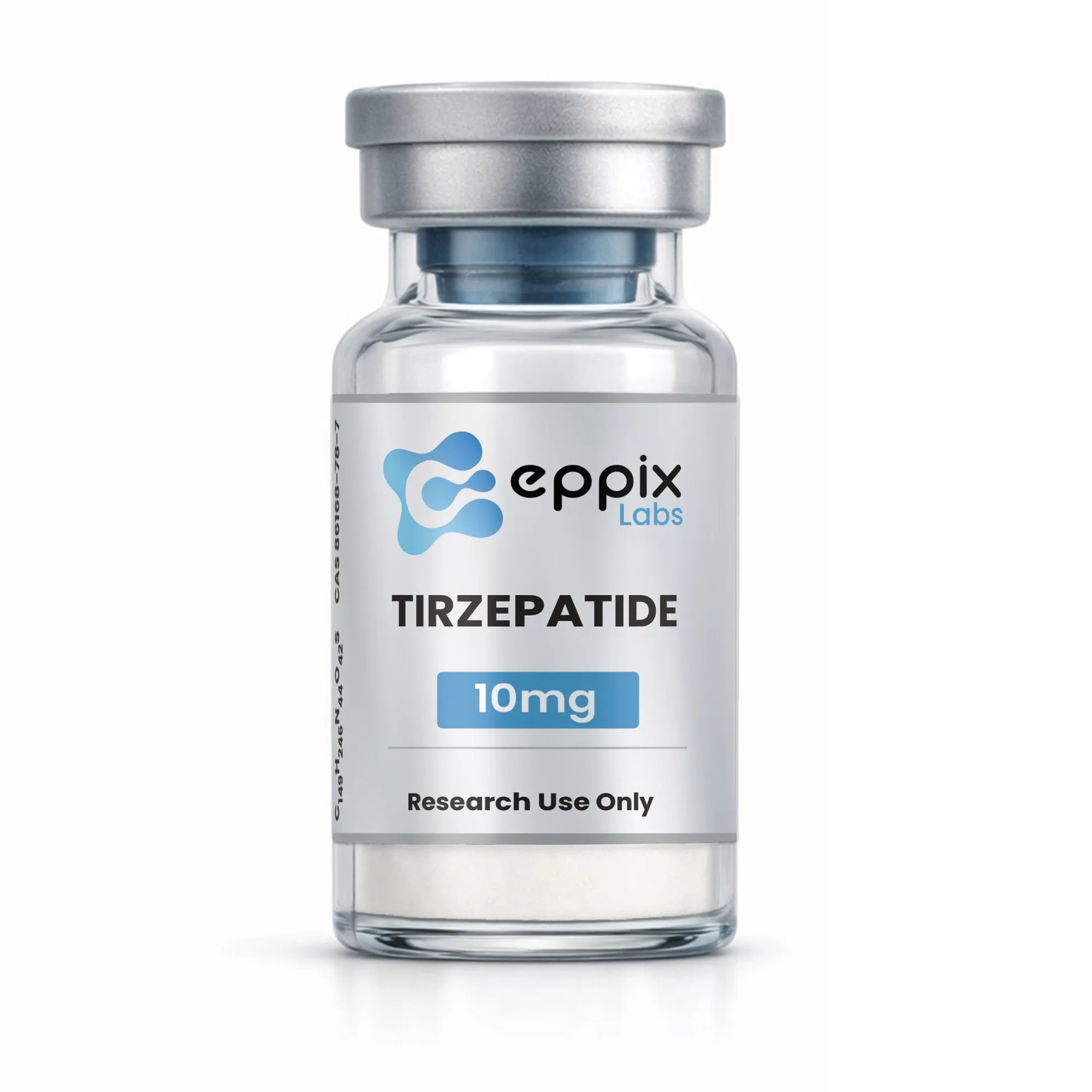
A supplier that publishes per-lot certificates can be audited by anyone holding a vial. A supplier that publishes a single product-level document cannot. Eppix publishes one page per tested lot, and a batch lookup that takes the code from the vial directly.
What HPLC purity actually measures

Purity on a peptide COA is normally determined by high-performance liquid chromatography. The sample is separated into its components, each component produces a peak, and purity is reported as the area of the target peak as a percentage of total peak area. A result of 99.6% means the target compound accounted for 99.6% of the detected material.

Two limitations follow directly from that method, and both matter when reading the number. First, it is relative: purity describes the proportion of what was detected, not an absolute quantity. Second, it only counts what the detector sees. Most peptide HPLC uses UV detection at a wavelength where the peptide bond absorbs, so material that does not absorb there — residual salts, water, some solvents — is not represented in the peak area at all.

That is not a flaw in the method; it is what the method is for. It does mean a very high purity figure is compatible with a vial that contains substantially less peptide than its label claims, because the two questions are simply different. Purity asks *what fraction of the material is the compound*. It does not ask *how much compound is there*.

The second number: measured mass against the label

The question purity leaves open is answered by a quantitative assay — the measured mass of compound actually present in the vial, compared against the amount printed on the label. Expressed as a percentage, this is fill accuracy.

A worked example makes the gap concrete. Take a vial labelled 10 mg that assays at 99.8% purity and is found to contain 7.1 mg of material. The purity result is completely accurate: of the 7.1 mg present, 99.8% is the target compound. The vial is also 29% short of its label. A supplier publishing only the purity figure has told you something true and left out the thing you were actually buying.

This is the check most certificates in this market do not support, because the quantitative assay is a separate test that costs more and sometimes returns unflattering results. When a supplier does publish it, the useful follow-up question is whether they publish it *always* — including on lots that came in under 100% — or only when the number is favourable. A supplier who publishes only flattering numbers is providing marketing, not verification.

  • ·Purity — what fraction of the material present is the target compound
  • ·Measured mass — how much target compound was actually in the vial
  • ·Expected content — what the label claims
  • ·Fill accuracy — measured mass as a percentage of expected content

Identity: confirming it is the right compound at all

Purity and mass both presuppose that the material is the compound named on the label. Identity is confirmed separately, normally by mass spectrometry: the measured molecular mass of the sample is compared against the theoretical mass calculated from the compound's formula. A close match confirms the molecule is what it claims to be.

This check is worth reading rather than skimming, because it catches a category of error the purity figure cannot. A truncated synthesis product missing a residue, or a closely related analogue, can chromatograph as a clean single peak and return an excellent purity result while being the wrong molecule. The mass spectrum is what separates those cases.

On a certificate, look for an observed mass reported alongside the expected mass. The published sequence, molecular formula and CAS number for the compound — all of which appear on the product pages here — are what the observed figure should be checked against.

Who ran the test, and can you reach the original?

A certificate is only as independent as the laboratory that produced it. An in-house result is not necessarily wrong, but it is not third-party verification, and a document that does not name its laboratory at all should be treated as unverified.

Where an independent laboratory issues the report, the strongest form of publication is a link to the laboratory's own record of that test — a page hosted by the lab, not by the supplier. That closes the last gap in the chain, because it means the figures cannot have been edited between the laboratory and the page you are reading. The batch pages on this site link out to the issuing laboratory's own record for exactly that reason.

Be wary of the reverse pattern: a summarised certificate, presented as an image, with the laboratory named but no route back to the original. Nothing about that arrangement is verifiable by the reader.

The short version

Six checks, in the order they are worth doing. Any certificate that fails the first two is not evidence about your vial, however good the purity figure looks.

  • ·Does the lot code on the certificate match the code printed on the vial?
  • ·Is there one certificate per lot, or one certificate for the whole product?
  • ·Is a measured mass published alongside purity, or purity alone?
  • ·Are under-100% fill results published too, or only favourable ones?
  • ·Is identity confirmed by mass spectrometry against the expected mass?
  • ·Is the issuing laboratory named, and can you reach its own record of the test?

Frequently Asked

Is a 99% purity claim meaningful on its own?

Only partly. It describes the proportion of detected material that is the target compound, which is worth knowing, but it says nothing about how much material is in the vial or whether the molecule is the right one. Purity is one of three independent questions, and it is the one every supplier answers.

What is fill accuracy?

The measured mass of compound in the vial expressed as a percentage of the amount claimed on the label. A vial labelled 10 mg found to contain 10.98 mg is at 109.8%; one containing 7.1 mg is at 71%. It is the figure that tells you whether you received what you paid for, and it is independent of purity.

Why can a vial be 99.8% pure and still be short?

Because purity is a ratio, not a quantity. It reports the target compound as a fraction of the material detected in the sample. If less material is present than the label claims, that ratio can still be very high — the result is accurate and the vial is still short. Only a quantitative assay answers the second question.

How do I verify a certificate belongs to my vial?

Match the lot code printed on the vial to the lot code on the certificate. On this site you can enter that code into the batch lookup at /verify and it will return the report for that specific lot, including measured purity, measured mass and fill accuracy.

Research Use Only

This article summarizes published preclinical research literature. Compounds referenced are supplied by Eppix Labs strictly as research materials for laboratory investigation within Canada. They are not approved by Health Canada for human or veterinary use, and nothing on this page should be interpreted as medical advice or guidance on human or animal administration.