Canada Post Xpresspost1–2 day delivery across CanadaFree on orders over $200

Compound Comparison

CJC-1295 With DAC vs Without DAC: One Suffix, an Order of Magnitude

The two compounds most often confused with each other in this catalogue, and the confusion is not harmless: they behave completely differently in time

·By Adam Reeves · Research Editor, Eppix Labs

No two compounds on the research market are conflated more often than CJC-1295 with DAC and CJC-1295 without DAC. They are sold under one name with a suffix that half the market omits, and the omission matters, because the two molecules differ in circulating half-life by roughly two orders of magnitude.

This page sets out what the modification is, what it changes, and how to tell from a certificate which molecule is in a vial. Both are supplied as laboratory research materials only, and nothing here is dosing or administration guidance. The pairing context is covered in buy CJC-1295 and ipamorelin in Canada.

What DAC actually is

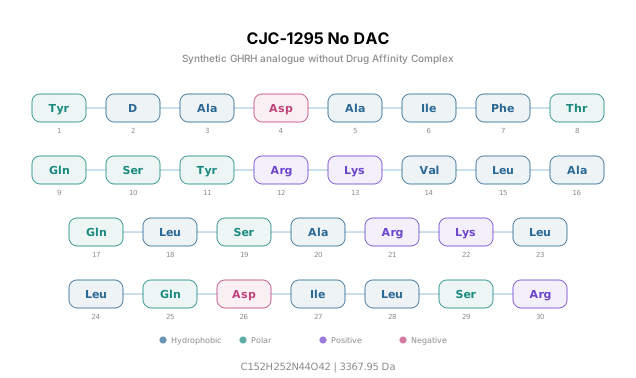
Both compounds start from the same base: a modified fragment of growth-hormone-releasing hormone, GHRH(1-29), carrying four amino-acid substitutions that resist enzymatic degradation. That molecule is the one commonly sold as CJC-1295 without DAC, and equally commonly as Mod GRF 1-29. The two names denote the same sequence.

DAC stands for drug affinity complex: a maleimidopropionic acid group attached to the peptide that reacts with a free thiol on circulating serum albumin, covalently tethering the peptide to a protein with a multi-day residence time in plasma.[1] The consequence is not subtle. Instead of clearing on the order of half an hour, the conjugated peptide persists for days, and published pharmacokinetic work put the terminal half-life in the range of about a week.[1]

So the suffix is not a formulation detail or a grade. It is a covalent modification that changes the molecular weight and changes the compound's entire temporal behaviour.
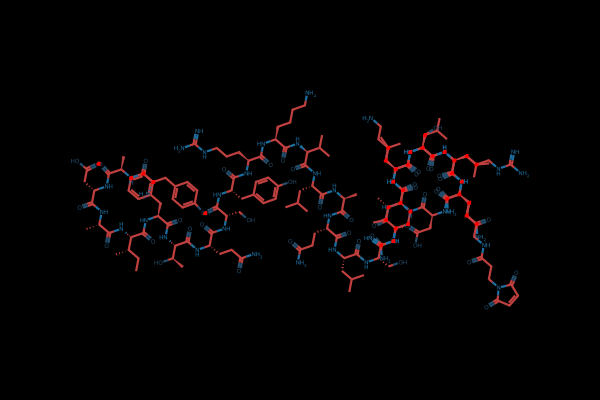
Amino Acid Sequence
Amino Acid Sequence diagram
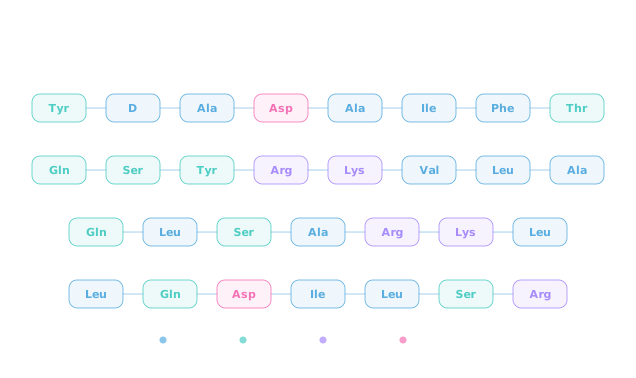
The shared base: modified GHRH(1-29), the molecule sold as CJC-1295 without DAC or Mod GRF 1-29.
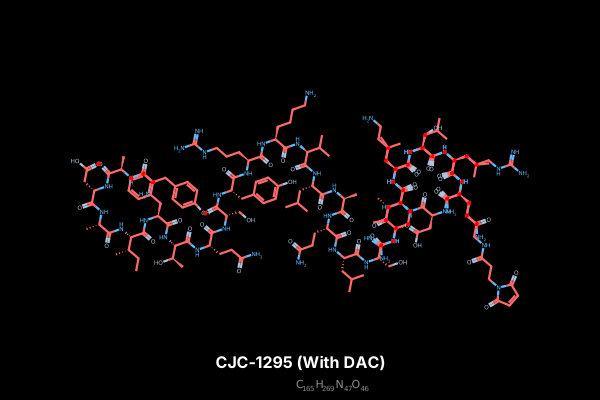
Chemical Structure
Chemical Structure diagram
With the drug affinity complex attached. The added group is visible in the structure and, more usefully, in the measured mass.

Side by side

  • ·Base sequence. Identical in both: GHRH(1-29) with four stabilising substitutions.
  • ·Modification. Without DAC: none beyond those substitutions. With DAC: an albumin-binding maleimidopropionic acid group.
  • ·Half-life class. Without DAC: on the order of half an hour. With DAC: on the order of days, with published work reporting roughly a week.[1]
  • ·Signal pattern in models. Without DAC: a short pulse, which is what makes it usable for modelling the pulsatile release the GHRH axis actually runs on. With DAC: a continuous elevation, which models sustained receptor stimulation instead.
  • ·Typical pairing. The non-DAC form is commonly paired with a growth-hormone secretagogue so the two signals arrive together. The DAC form is more often studied on its own, because its whole point is that its signal does not stop.

Why the difference is the research question

Endogenous growth hormone is released in pulses, not as a steady level, and a large part of GHRH-axis research is about what that pulsatility does. Having both forms available is what makes the comparison possible: the non-DAC form approximates a pulse, the DAC form holds the signal on, and the difference between the two is the experiment.

That is also why an unspecified listing is a genuine problem rather than a labelling annoyance. A vial sold as "CJC-1295" with no suffix is an uncontrolled experimental variable, because the two molecules produce different signal shapes from the same nominal compound. A supplier that does not state which one it is either does not know or does not think it matters, and neither answer is reassuring.

How the certificate settles it

This is one of the cleanest cases in the catalogue for identity testing earning its keep. The DAC group adds mass, so the two molecules have different theoretical molecular weights, and a mass-spectrometric identity result distinguishes them without ambiguity. Purity cannot: a vial of the wrong one of the two produces a perfectly clean chromatogram.

The general point is made at length in mass spectrometry in peptide verification and what HPLC testing cannot prove. The practical version is short: check that the certificate names the variant, and check that the found mass matches the variant it names.

Where both forms are stocked they are listed as separate products with their own lot certificates, published before sale and verifiable on the testing laboratory's own database. A supplier that sells them under one undifferentiated listing has not done that work.

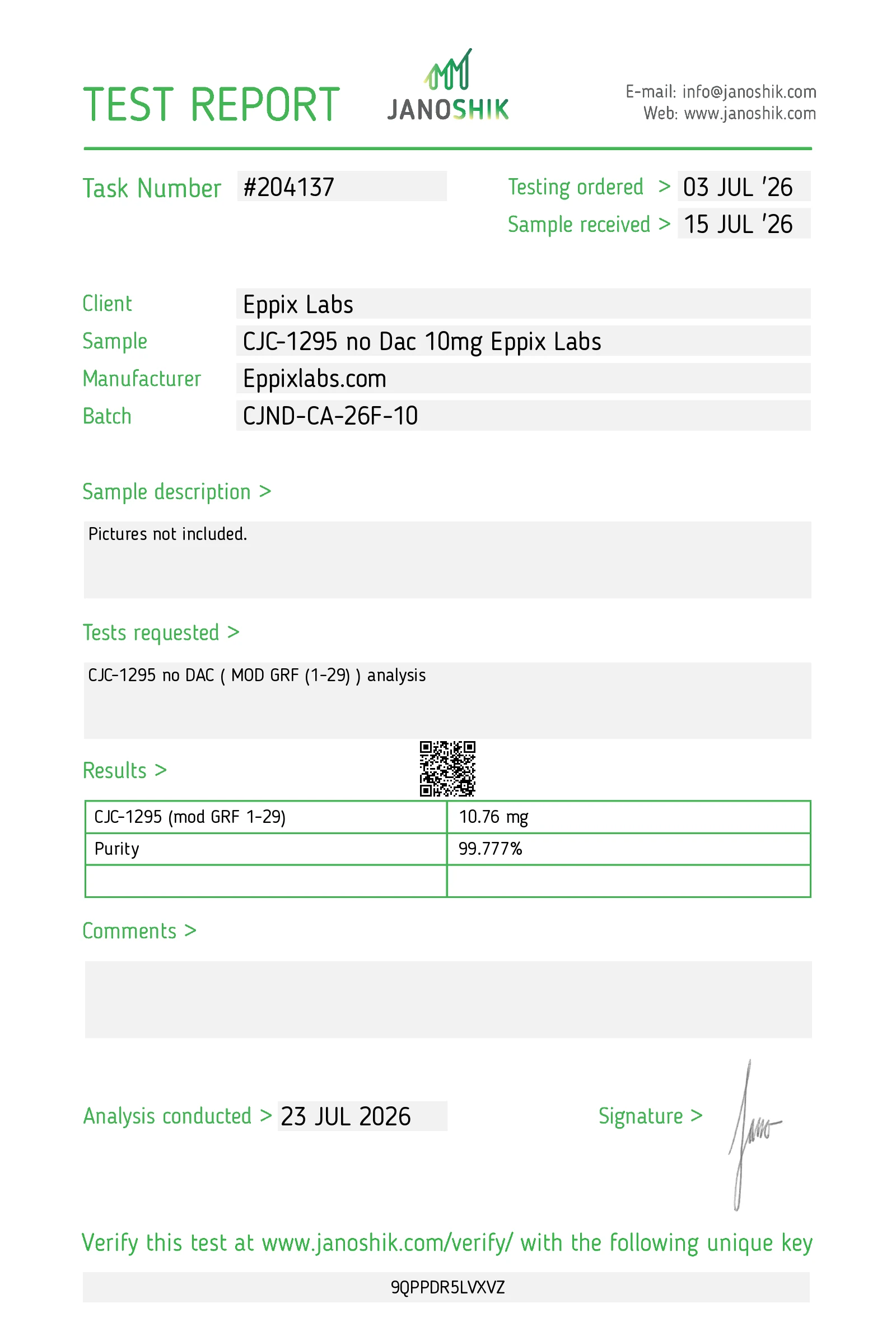
Published Certificate
Certificate of analysis for Buy CJC-1295 No DAC Canada | Mod GRF 1-29 10mg, batch CJND-CA-26F-10, 99.777% purity, 10.76 mg measured content
Batch
CJND-CA-26F-10
Purity (HPLC)
99.777%
Measured content
10.76 mglabelled 10 mg
Laboratory
Janoshik
Current published certificate for the non-DAC form, the one stocked here.

Regulatory and anti-doping position

Neither form is an authorised health product in Canada. Both are supplied strictly as laboratory research materials, with no DIN, no NPN and no Health Canada authorisation for human or veterinary use.

GHRH analogues also appear on the World Anti-Doping Agency Prohibited List, which is a separate system from Canadian law and applies to athletes in tested sport regardless of a substance's legal status. The distinction is set out in peptides and anti-doping.

Frequently Asked

Is Mod GRF 1-29 the same as CJC-1295 without DAC?

Yes. They are two names for the same modified GHRH(1-29) sequence. "Mod GRF 1-29" is the name that came out of research forums; "CJC-1295 no DAC" is the name the market settled on.

Which one is better?

Neither. They model different signalling patterns. The non-DAC form approximates the pulsatile release the axis normally runs on; the DAC form models sustained stimulation. The choice follows the research question.

How can I tell which one is in a vial?

Mass spectrometry on the lot certificate. The drug affinity complex changes the molecular weight measurably, so the found mass distinguishes the two. Purity testing cannot tell them apart.

Why do listings often just say "CJC-1295"?

Usually carelessness, sometimes worse. Either way it leaves the buyer with an unspecified molecule. Ask for the certificate, and check that it names the variant and reports a mass consistent with it.

Are they legal in Canada?

Both may be supplied for laboratory research. Neither is authorised for human or veterinary use, and GHRH analogues are prohibited in tested sport under the WADA list. This is general information, not legal advice.

References

  1. Teichman, S.L. et al. (2006). Prolonged stimulation of growth hormone (GH) and insulin-like growth factor I secretion by CJC-1295, a long-acting analog of GH-releasing hormone, in healthy adults. J Clin Endocrinol Metab 91(3):799-805. PMID 16352683
  2. Ionescu, M., Frohman, L.A. (2006). Pulsatile secretion of growth hormone (GH) persists during continuous stimulation by CJC-1295, a long-acting GH-releasing hormone analog. J Clin Endocrinol Metab 91(12):4792-4797. PMID 17018654
  3. Guillemin, R. et al. (1982). Growth hormone-releasing factor from a human pancreatic tumor that caused acromegaly. Science 218(4572):585-587. PMID 6812220

Research Use Only

This article summarizes published preclinical research literature. Compounds referenced are supplied by Eppix Labs strictly as research materials for laboratory investigation within Canada. They are not approved by Health Canada for human or veterinary use, and nothing on this page should be interpreted as medical advice or guidance on human or animal administration.