Canada Post Xpress1–2 day delivery across CanadaFree on orders over $200

Verification

Janoshik Testing Explained: How Every Eppix Batch Is Verified

What the laboratory measures, what its certificates report, and how to check any of ours on its database in two minutes

·Compiled by Eppix Labs

Competitors write blog posts about Janoshik Analytical. We publish Janoshik results for every lot we sell, before we sell it. This page explains what the laboratory actually measures, what its certificates report, and how to verify any Eppix certificate on the laboratory's own database, because the point of independent testing is that you do not have to take our word for anything.

Who Janoshik is

Janoshik Analytical is an independent analytical laboratory that has become the de-facto standard for third-party testing in the research peptide market. Its position rests on two things.

The first is method fit: HPLC for purity and mass spectrometry for identity and quantitative content, which are the appropriate techniques for peptide chemistry rather than generic assays borrowed from another field.

The second, and the more important one commercially, is a public verification system. Every certificate carries a unique key that anyone can check on the laboratory's own site. A supplier can produce a convincing PDF. A supplier cannot produce an entry in someone else's database. That single property is what makes "Janoshik-tested" mean something when other testing claims do not.
What a Janoshik certificate reports

Purity, by HPLC. High-performance liquid chromatography separates the sample into its components and reports what percentage of the peptide content is the stated compound, as area percent. This answers one question: of what is in the vial, how much is the right molecule? It says nothing about how much is there.

Identity and content, by mass spectrometry. MS confirms that the molecule's mass matches the stated compound, which is the check that catches substitution, and quantitative work reports the measured milligrams in the vial. That second figure is the one most of the market omits, because it is the one that exposes underfilling.

The distinction between those two numbers is the subject of a separate explainer at purity vs fill accuracy.

Published Certificate
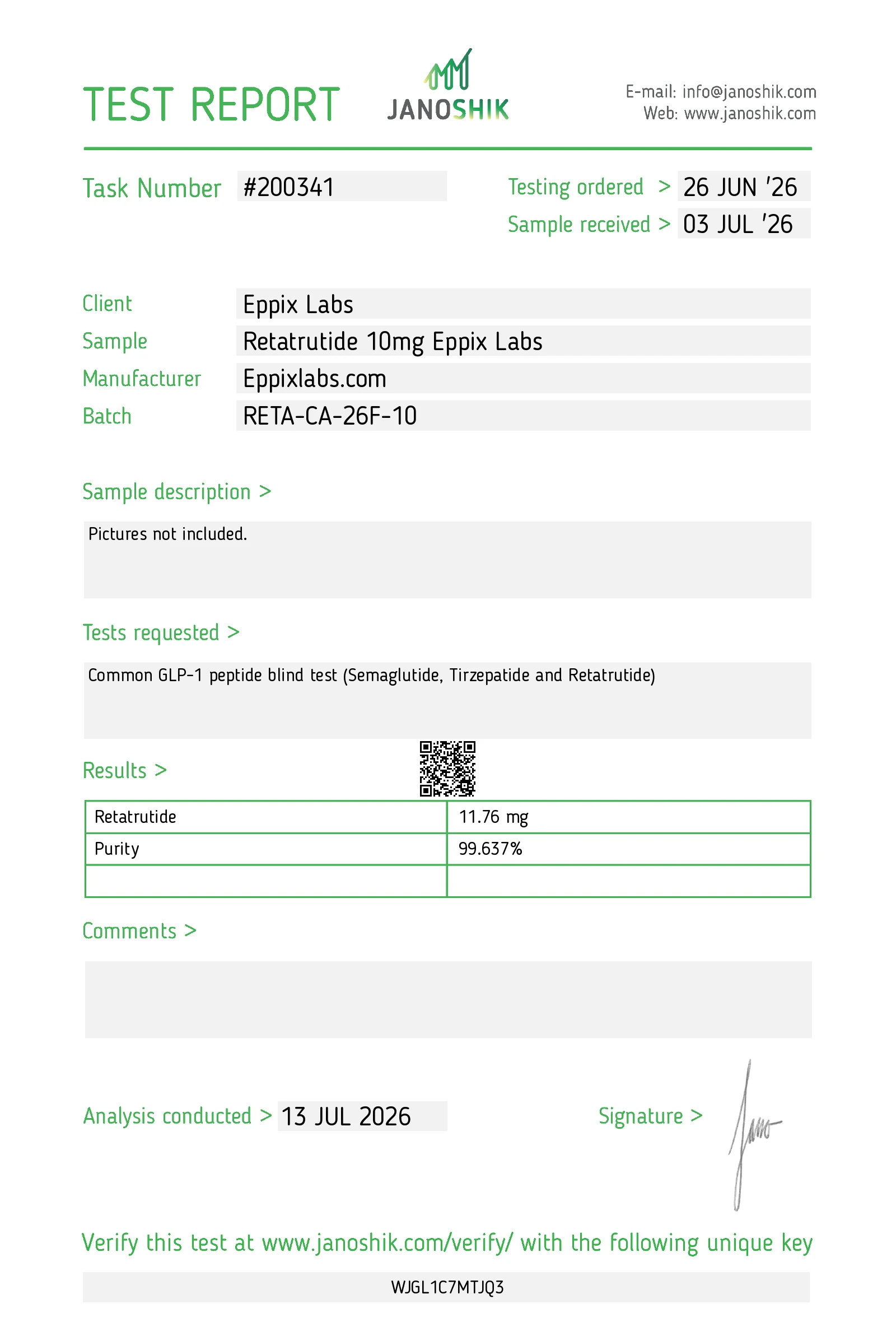
Certificate of analysis for Buy Retatrutide Canada | Triple Agonist 10mg, batch RETA-CA-26E-01, 99.637% purity, 11.76 mg measured content

Select strength

Batch
RETA-CA-26E-01
Purity (HPLC)
99.637%
Measured content
11.76 mglabelled 10 mg
Laboratory
Janoshik
A published Janoshik certificate as it appears here: batch, HPLC purity, measured content against the labelled amount, and a direct link to the report on the laboratory's database.

Why certificates do not all look the same

Three legitimate report shapes turn up in the archive, and knowing which is which prevents a correct certificate from looking like an incomplete one.

  • ·Single analyte with purity. The standard shape: one compound, one purity figure, one measured mass. Most of the catalogue.
  • ·Blends, with no purity figure. HPLC purity is defined against a single analyte, so a two-compound vial cannot carry one meaningful percentage. A correct blend certificate reports measured mass per component with identity confirmed for each. The CJC-1295 and ipamorelin certificates take this form.
  • ·Dual-unit mass. Some compounds are conventionally reported in two units at once, and the certificate carries both rather than converting silently.

The Eppix testing pipeline

  • ·Every lot, no exceptions. Each production lot is sampled and sent for testing before it is listed. Not periodic testing, not a representative batch from last year: the lot you are buying.
  • ·Published before sale. The certificate goes into the public archive at certificates of analysis and is linked from the product page, carrying the batch code printed on every vial label.
  • ·Verifiable at the source. Take any Eppix certificate's key to the laboratory's site and compare it against what we published. Vial, to batch code, to our certificate page, to the laboratory's database: the chain is checkable end to end, and the batch lookup is at verify.
  • ·Per strength, not per product. A 10 mg lot and a 20 mg lot are different lots with different certificates. The strength buttons under every certificate on this site switch between them rather than showing one certificate for all.

Why the order matters

Publishing before sale rather than on request is a structural commitment rather than a customer-service one. A supplier that publishes results before listing has removed its own ability to quietly not list a poor lot: the certificate exists on a third party's database whether the number is flattering or not.

That is a stronger guarantee than any purity claim, because it does not depend on trusting anyone. It is the standard we think Canadian researchers should ask of every supplier rather than only of this one. The full checklist is at how to choose a peptide supplier in Canada.

What third-party testing does not establish

Worth stating plainly, because "lab tested" gets used as though it settled every question.

  • ·It does not make a compound safe, approved, or suitable for human use. Every compound in this catalogue is a research material and none is authorized by Health Canada for human or veterinary use.
  • ·It does not establish efficacy. A certificate is about the contents of a vial, not about what those contents do.
  • ·It is a measurement on a date, not a prediction. Correct storage from that date onward is the buyer's responsibility. See the peptide storage guide.
  • ·It does not test sterility or endotoxin unless those assays were specifically commissioned, which for research material they generally are not.

Frequently Asked

What makes Janoshik certificates trustworthy?

The public verification database. Every report carries a unique key that resolves on the laboratory's own site, so a certificate can be confirmed independently of whoever published it. A PDF can be fabricated; an entry in a third party's database cannot.

Does Eppix test every batch or only some?

Every lot, before it is listed. The public archive grows with each lot, and each certificate carries the batch code printed on the vial label.

How do I verify my specific vial?

Take the batch code from the vial label to the verify page, open the certificate, and check its key on the laboratory's site. Compare client, batch, date and numbers.

What happens if a lot tests below standard?

It does not get listed. The published archive is the record of what passed, which is the point of publishing before sale rather than on request.

Why does a blend certificate have no purity percentage?

HPLC purity is defined against one analyte. A two-compound vial has no single meaningful percentage, so the correct report gives measured mass per component with identity confirmed for each.

Does lab testing mean a compound is safe for human use?

No. Testing establishes what is in the vial. It says nothing about safety, efficacy or authorization, and every compound here is supplied as a research material only.

Research Use Only

This article summarizes published preclinical research literature. Compounds referenced are supplied by Eppix Labs strictly as research materials for laboratory investigation within Canada. They are not approved by Health Canada for human or veterinary use, and nothing on this page should be interpreted as medical advice or guidance on human or animal administration.