Canada Post Xpresspost1–2 day delivery across CanadaFree on orders over $200

Verification

What Is HPLC Testing, and What Can It Not Tell You?

Every peptide supplier in Canada cites HPLC and almost none explain it, because an explained number is a checkable number. Here is what the test measures and where its two blind spots are

·By Adam Reeves · Research Editor, Eppix Labs

HPLC is the number every supplier quotes and the one most buyers stop at. It is a real measurement and a useful one, and it answers exactly one of the three questions a certificate has to answer. Knowing which one it answers is what turns a percentage on a page into a check you can actually run.

This page explains the method, how to read the figure, and the two blind spots that make an HPLC-only claim half a story. It sits alongside mass spectrometry in peptide verification and purity vs fill accuracy, which cover the other two questions.

How the method works

High-performance liquid chromatography pushes a dissolved sample through a packed column under pressure. Different molecules interact with the column packing to different degrees, so they travel through it at different speeds and leave it at different times. For a peptide sample that means the intact target sequence, the truncated fragments left over from synthesis, and any other impurities separate into distinct peaks on a chromatogram, each peak recorded as the detector sees the compound elute.

The purity figure is the target peak's share of total peak area. A batch reported at 99.5% means 99.5% of what the detector saw was the intact target sequence. Reversed-phase HPLC is the standard configuration for peptides, and it has been the workhorse for identity, purity and potency control of biomolecules used as drugs since the technique matured.[1]

That framing matters for what follows: the figure is a ratio of what the detector saw. It is not a measure of how much material was in the vial, and it is not a statement about which molecule produced the big peak.
Reading the number on a real certificate

  • ·99% or better is the research-grade convention. Published lots here typically fall in the 99.2 to 99.9 range, and the exact figure moves lot to lot because coupling efficiency and purification cuts genuinely vary between runs.
  • ·Variation between lots is the honest pattern. A catalogue where every product reports the same flawless number is describing a document, not a series of measurements. Real analysis produces a distribution.
  • ·The remaining fraction is mostly synthesis by-products. Deletion sequences, the target chain minus one residue, are the characteristic impurity, and they accumulate with sequence length. Why that happens is set out in how peptides are made.
  • ·A slightly lower figure is not automatically fraud. It should be disclosed rather than rounded away. What is not acceptable is a number with no lot behind it.

Blind spot one: HPLC does not establish identity

HPLC shows that one compound dominates the sample. It does not show which compound. A vial of an entirely different peptide, competently purified, produces a beautiful 99% chromatogram, because the number describes homogeneity rather than identity.

Establishing identity requires mass spectrometry: measuring the molecular weight of what is in the vial and comparing it against the theoretical mass fixed by the target sequence.[2] This is the check that catches substitution, and substitution is the most profitable fraud available in this market precisely because purity testing cannot see it. The detail is in mass spectrometry in peptide verification.

Blind spot two: HPLC does not establish quantity

Purity is a ratio, not an amount. A vial labelled 10 mg that actually holds 6 mg of 99.5% pure peptide reports 99.5%, because 99.5% of the 6 mg that was there is the target compound. The purity figure is mathematically incapable of noticing the missing 4 mg.

Answering the quantity question requires measured content: quantitative analysis reporting the milligrams actually in the vial against the labelled claim. That figure is the one short-filling depends on you never seeing, which is why underfilled vials exists as its own article.

What a complete certificate carries

Three figures: HPLC purity, mass-spectrometric identity, and measured content, all against a named lot and all from a named laboratory. Two of the three is an incomplete answer. One of the three is marketing.

The other half of the standard is external checkability. A certificate that exists only as a PDF on a supplier's own site can be anything; a certificate carrying a verification key that resolves on the testing laboratory's database cannot be edited after the fact. Every lot published here carries all three figures and that key, before the lot goes on sale.

Published Certificate
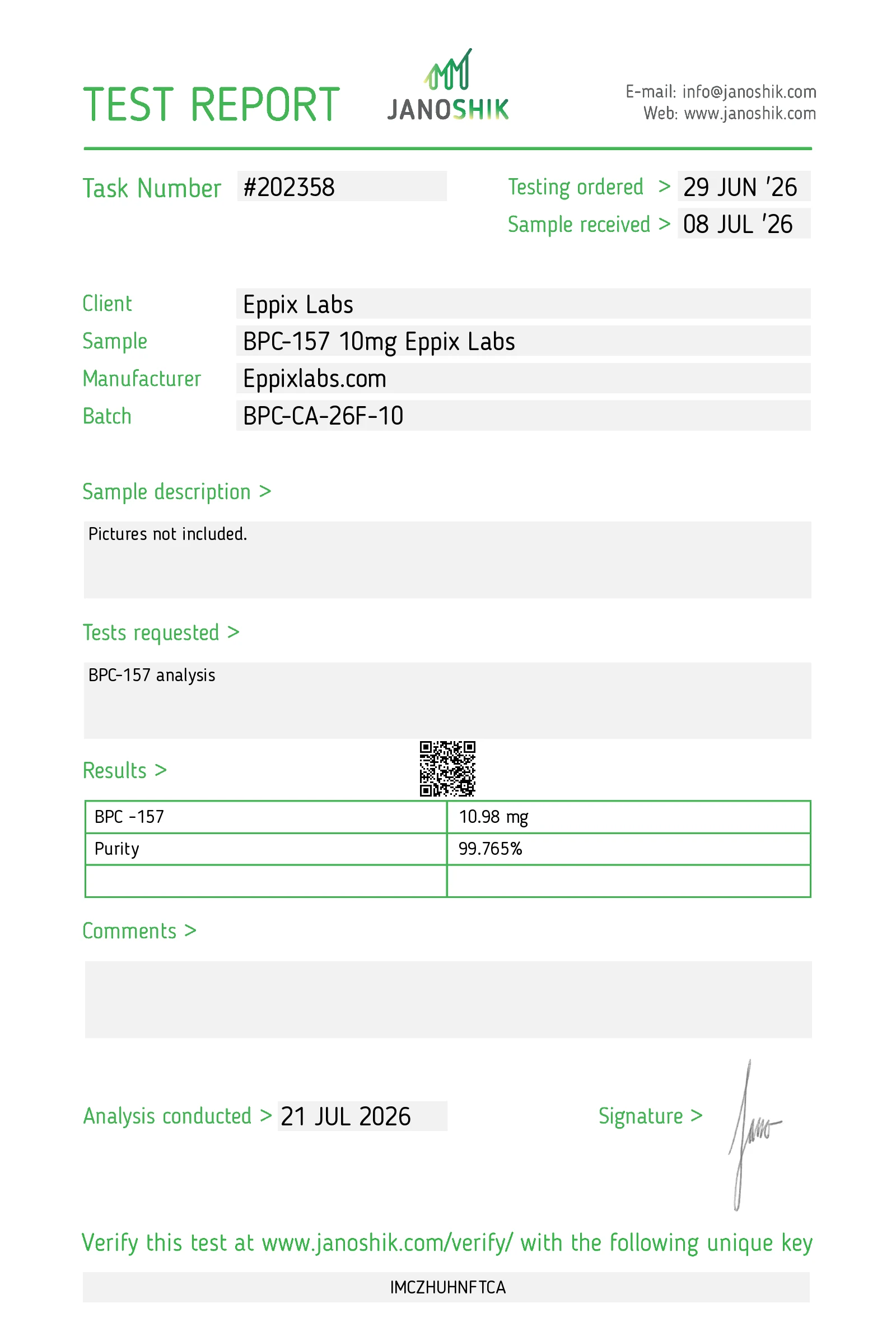
Certificate of analysis for Buy BPC-157 Canada | 10mg & 20mg Vials 10mg, batch BPC-CA-26F-10, 99.765% purity, 10.98 mg measured content

Select strength

Batch
BPC-CA-26F-10
Purity (HPLC)
99.765%
Measured content
10.98 mglabelled 10 mg
Laboratory
Janoshik
A current published certificate. Purity is one line of it; identity and measured content are the other two.

Frequently Asked

Is 98% purity bad?

For research-grade supply the convention is 99% or better. A slightly lower figure is not automatically fraud, but it should be disclosed on the certificate rather than rounded up in marketing copy.

Can HPLC results be faked?

A PDF can be edited by anyone. A certificate carrying a verification key that resolves on the testing laboratory's own database cannot be, which is why external verification matters more than the document itself.

What is a chromatogram?

The output graph: detector response against elution time. The large peak is the target compound, and the small ones are the impurities the purity percentage subtracts.

Why does purity vary between lots?

Because coupling efficiency, purification cuts and recovery genuinely vary between synthesis runs. A published set of identical numbers across a whole catalogue is the anomaly, not the reassurance.

If purity is not enough, what else should I ask for?

Mass-spectrometric identity, so you know which molecule was measured, and measured content, so you know how much of it is in the vial. All three belong on one lot certificate.

References

  1. Farid, N.A., Atkins, L.M., Becker, G.W. (1989). Liquid chromatographic control of the identity, purity and "potency" of biomolecules used as drugs. J Pharm Biomed Anal 7(2):185-188. PMID 2488619
  2. Aebersold, R., Mann, M. (2003). Mass spectrometry-based proteomics. Nature 422(6928):198-207. PMID 12634793
  3. Ashraf, A.R., Mackey, T.K., Vida, R.G. et al. (2024). Multifactor quality and safety analysis of semaglutide products sold by online sellers without a prescription: market surveillance, content analysis, and product purchase evaluation study. J Med Internet Res 26:e65440. PMID 39509151

Research Use Only

This article summarizes published preclinical research literature. Compounds referenced are supplied by Eppix Labs strictly as research materials for laboratory investigation within Canada. They are not approved by Health Canada for human or veterinary use, and nothing on this page should be interpreted as medical advice or guidance on human or animal administration.