Buy BPC-157 Canada | 10mg & 20mg Vials
Janoshik
Batch BPC-CA-26F-10
Buy BPC-157 Canada | 10mg & 20mg Vials
Recovery Compound
BPC-157 is a synthetic peptide studied in laboratory and preclinical research for its potential effects on tissue repair mechanisms, including cellular signaling related to inflammation and wound healing. Researchers investigate how it may influence molecular processes related to cell communication, vascular signaling, and protein regulation.
This product is intended strictly for laboratory research use within Canada. It is not approved by Health Canada for the diagnosis, treatment, cure, or prevention of any disease. Not for human or veterinary use.
By purchasing, you confirm the material will be used solely for lawful research purposes in accordance with applicable Canadian regulations.
BPC-157 is a synthetic peptide derived from a fragment of a naturally occurring gastric protein. It is produced for laboratory research and studied within controlled experimental environments.
In scientific literature, BPC-157 has been explored for its involvement in angiogenic and inflammatory signaling processes, contributing to ongoing research focused on cellular response mechanisms and structural recovery models.
Third-party tested for purity, ID, quantity.
BPC-157 (Body Protection Compound-157) is a stable 15–amino acid peptide fragment first characterized in the early 1990s during investigations of gastric cytoprotective compounds. Since its identification, it has been evaluated across multiple preclinical research models.
Experimental studies have examined its influence on angiogenesis, nitric oxide pathways, collagen organization, and cytoprotective signaling. Within controlled laboratory settings, these findings have positioned BPC-157 as a compound of continued interest in structural integrity, connective tissue research, and systemic resilience models.
BPC-157 was originally synthesized during research into protective peptides present in gastric tissue. Early experimental models focused on gastrointestinal integrity, with subsequent investigations expanding into musculoskeletal, vascular, and dermal systems.
Over time, BPC-157 became a recurring subject in laboratory research due to its measurable biological activity across diverse preclinical models.
Preclinical investigations have explored BPC-157 in structural, vascular, and inflammatory research models. Laboratory data suggest involvement in angiogenic signaling, nitric oxide modulation, collagen-related pathways, and cytoprotective mechanisms under experimental conditions.
3 of the 4 areas below are addressed directly by a paper cited on this page.
Structural models involving tendon and ligament systems
Addressed on this page by Staresinic 2003, Chang 2011. The work appeared in J Orthop Res. Each is linked to its source record in the references below, so what was measured — and in what system — can be read rather than taken on trust.
- Staresinic, M. et al. (2003) — Gastric pentadecapeptide BPC 157 accelerates healing of transected rat Achilles tendon and in vitro stimulates tendocytes growth. J Orthop Res 21(6):976–983.
- Chang, C.H. et al. (2011) — The promoting effect of pentadecapeptide BPC 157 on tendon healing involves tendon outgrowth, cell survival, and cell migration. J Appl Physiol (1985) 110(3):774–780.
Vascular research focused on angiogenesis and nitric oxide signaling
Addressed on this page by Hsieh 2020, Huang 2015. The work appeared in Sci Rep and Drug Des Devel Ther. Each is linked to its source record in the references below, so what was measured — and in what system — can be read rather than taken on trust.
- Hsieh, M.J. et al. (2020) — Modulatory effects of BPC 157 on vasomotor tone and the activation of Src-Caveolin-1-endothelial nitric oxide synthase pathway. Sci Rep 10(1):17078.
- Huang, T. et al. (2015) — Body protective compound-157 enhances alkali-burn wound healing in vivo and promotes proliferation, migration, and angiogenesis in vitro. Drug Des Devel Ther 9:2485–2499.
Dermatological models examining wound closure processes
Addressed on this page by Huang 2015. The work appeared in Drug Des Devel Ther. Each is linked to its source record in the references below, so what was measured — and in what system — can be read rather than taken on trust.
- Huang, T. et al. (2015) — Body protective compound-157 enhances alkali-burn wound healing in vivo and promotes proliferation, migration, and angiogenesis in vitro. Drug Des Devel Ther 9:2485–2499.
Systemic models evaluating cytoprotective and inflammatory pathway interactions
No paper cited on this page reports on systemic, evaluating or cytoprotective. This heading marks where BPC-157 is discussed in the category rather than a question the cited literature answers, and it is worth knowing which of these areas has work behind it and which does not.
The references section of this page cites 8 primary papers published between 1993 and 2020 — a reasonably developed body of work for a research compound. Every citation is linked to its PubMed or DOI record so it can be read rather than taken on trust, and the summaries above describe what those papers report rather than what the compound is claimed to do.
Research compounds attract claims that outrun their evidence. Below are the ones most often encountered for BPC-157, set against what the papers cited on this page actually report. Where the record is thin or contested, that is stated rather than smoothed over.
BPC-157 is also referred to as BPC, body protection compound, the wolverine peptide.
Described online as a rapid healing agent for tendon, ligament and muscle injury.
Tendon and muscle healing has been examined in rodent models. Krivic and colleagues reported promoted tendon-to-bone healing in a rat Achilles detachment model, and Staresinic and colleagues reported accelerated healing of transected rat Achilles tendon with tendocyte outgrowth in vitro. These are animal and cell-culture findings. A 2025 systematic review in the HSS Journal synthesised 36 studies published between 1993 and mid-2024 and found 35 were preclinical animal studies and one was an uncontrolled human chart review — no completed controlled human efficacy trial exists.
Described as orally active, on the basis that it originates in gastric juice and therefore survives digestion.
Oral administration has been reported as effective in rodent models by the originating research group, and the parent compound was indeed identified in human gastric juice. Neither fact establishes oral bioavailability in humans, for which no published pharmacokinetic data exists. The same 2025 review documented a plasma half-life under 30 minutes and no human clinical safety data at all.
Described as having no side effects.
An absence of reported adverse effects in animal studies is not evidence of safety in humans, and no human clinical safety data has been published. A 2025 review and patent analysis in Pharmaceuticals raised concerns specifically about the compound's pro-angiogenic and nitric-oxide-related activity; the originating group published a comment defending the safety profile and the review authors replied, noting that experiments routinely use only one or two fixed dose levels and that consequently there is no data on higher, repeated or long-term exposure. That exchange is unresolved and worth reading in full.
Described as clinically approved, or as having passed clinical trials.
BPC-157 is not approved as a drug by Health Canada, the FDA or any other regulatory agency. Under the designation PL-14736 it did enter clinical investigation for inflammatory bowel disease, which is noted in Klicek and colleagues' 2008 paper on colocutaneous fistula healing in rats — but entering trials is not the same as completing them, and no controlled human efficacy results have been published.
Presented as having a large and independent body of supporting research.
The literature is substantial in volume but concentrated in source. The 2025 Pharmaceuticals exchange noted that over 80% of indexed BPC-157 records are linked to a single research group, the team at the University of Zagreb that first characterised the compound. Independent work does exist — a Taiwanese group has published on vasomotor tone and on VEGFR2-associated angiogenesis in Scientific Reports and the Journal of Molecular Medicine respectively — but a literature concentrated in one group has not been independently replicated to the degree its volume suggests.
Nothing above is a statement of what this material does. It is a summary of what has been published and what has not. Eppix Labs supplies research materials only and provides no dosing, administration or protocol guidance.
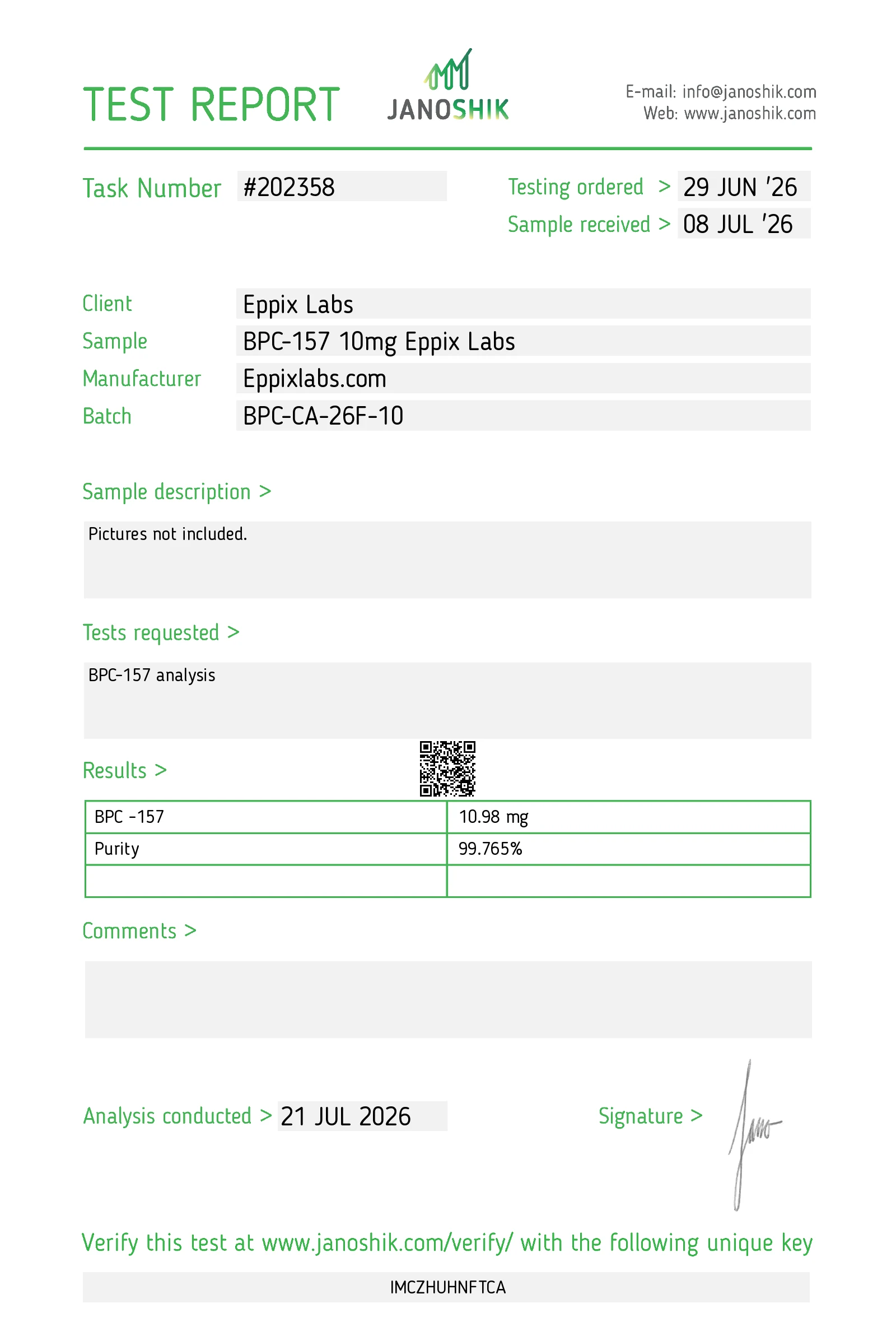
Verification for BPC-157 is per lot, not per product. Across the strengths currently stocked: 20mg lot BPC-CA-26A-01 returned 99.75% purity, 21.49 mg measured, 107.5% of the labelled 20 mg; 10mg lot BPC-CA-26F-10 returned 99.765% purity, 10.98 mg measured, 109.8% of the labelled 10 mg, assayed by Janoshik. Those figures are the laboratory's, published in full rather than reduced to a badge.
Purity is half the number. It states what fraction of the material in the vial is BPC-157; it says nothing about how much material is in the vial, and a short-filled vial can return a purity result that is entirely accurate. The figure that answers the second question is measured mass against expected content — for BPC-157, across the strengths stocked they run from 107.5% to 109.8% of label. Both numbers are published for every lot, whichever way they fall.
Each strength of BPC-157 carries its own lot code and its own certificate — BPC-CA-26A-01, BPC-CA-26F-10 are separate tests, not one result applied across the range. The code printed on the vial you receive is the one to match, and matching it is what ties the material in hand to a test that was actually run on it.
Researchers who buy BPC-157 in Canada through Eppix Labs receive the lot described by the certificate above: the code printed on the vial label is the code on the certificate, and both are searchable on the batch verification page.
- Lyophilized storage
- −20 °C long-term; stable at room temperature in transit
- After reconstitution
- 2–8 °C
- Light
- Protect from UV and direct light
- Freeze-thaw
- Avoid repeated cycles
- Vehicle
- Bacteriostatic water in most published protocols
- Format
- Lyophilized powder
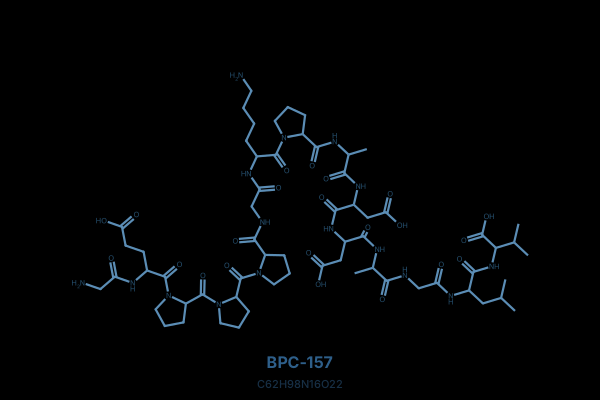
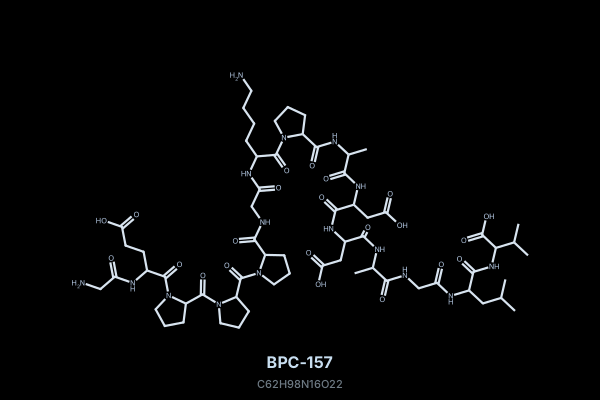
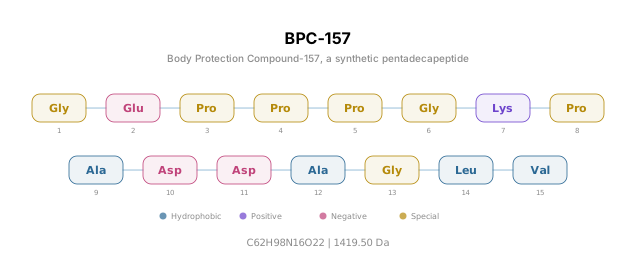
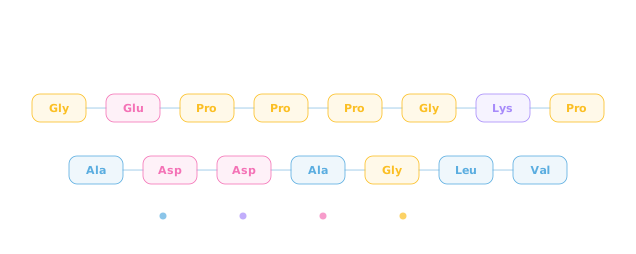
BPC-157 is supplied as lyophilized powder. In the dry state the material is comparatively stable, which is why it ships at ambient temperature without a cold chain; once reconstituted it is a peptide in solution and the handling constraints tighten considerably. At 15 residues it is short enough to be produced by solid-phase synthesis, and the published sequence on this page is what an identity assay is checked against.
Repeated freeze-thaw cycling is the handling error most likely to degrade material of this class, because each cycle concentrates solutes at the ice boundary. Where a protocol calls for the same vial across multiple sessions, the published literature generally describes aliquoting after reconstitution rather than re-freezing the whole volume.
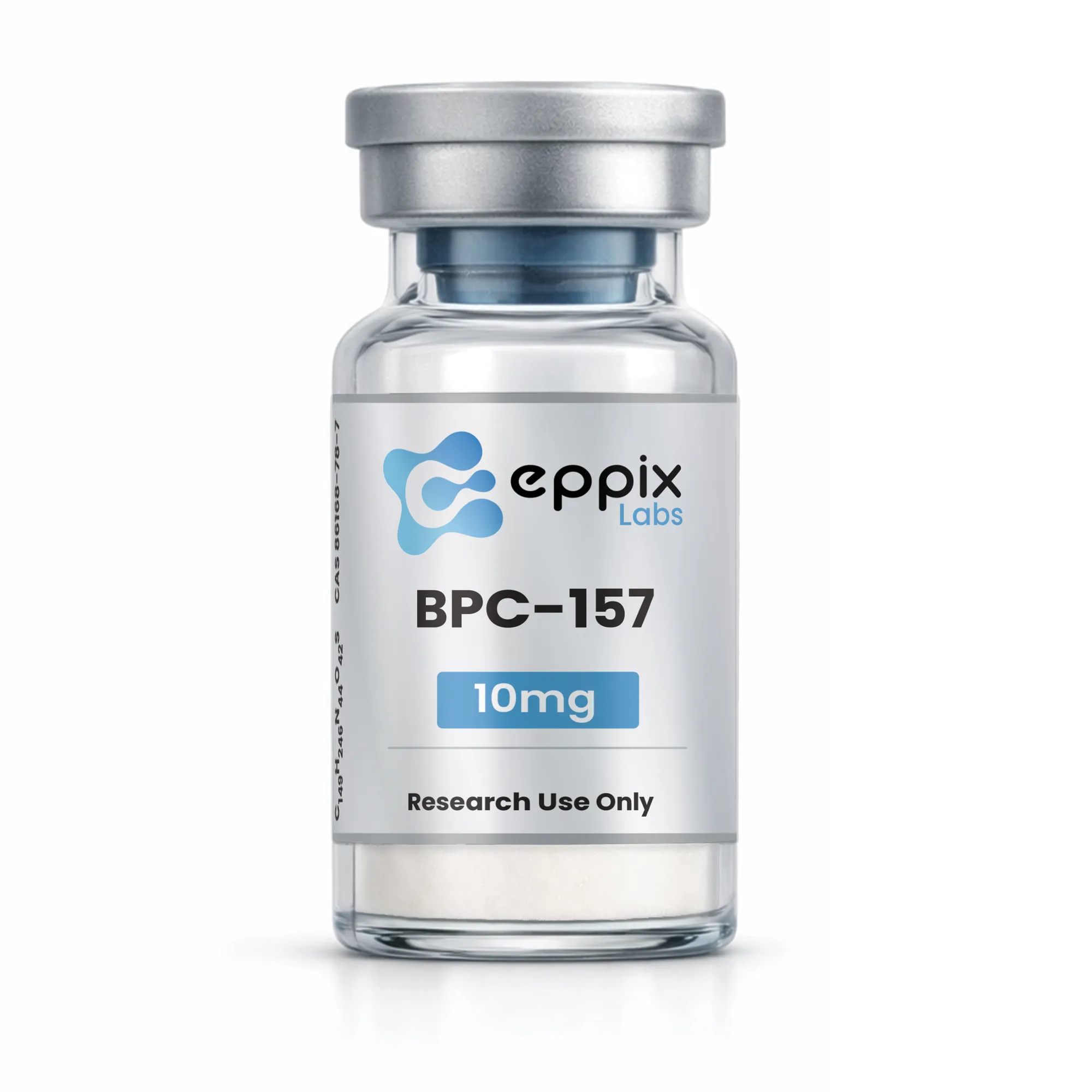
Vials may appear empty on arrival. Lyophilized material collects at the base of the vial and is often not visible until the vial is inspected under direct light.
- 1 × sealed glass vial in the strength selected (20mg / Single Vial, 10mg / Single Vial, 20mg / 5-Pack, 20mg / 10-Pack, 10mg / 5-Pack, 10mg / 10-Pack available), batch-labelled
- The batch-linked Certificate of Analysis for the exact lot shipped
- Discreet outer packaging with no product names on the exterior
- Canada Post Xpress, tracked, typically 1–2 business days from Alberta
- Bacteriostatic water or any other reconstitution vehicle
- Syringes, needles or filters
- Dosing, administration or protocol guidance of any kind
Reconstitution materials are sourced separately. The reconstitution calculator on this site works out concentrations for a given volume, but it is an arithmetic tool for laboratory record-keeping and not a protocol.
No. Eppix Labs products are supplied exclusively for laboratory research. We do not provide dosing, administration, or usage guidance.
Each vial contains the labeled quantity (10mg or 20mg) of lyophilized BPC-157. Independent third-party analysis verifies purity, identity, and net content per batch.
The vial contains only the lyophilized compound. Any laboratory materials required for reconstitution or experimental procedures must be sourced separately.
Duration depends entirely on research design, storage conditions, and laboratory protocol.
A new gastric juice peptide, BPC. An overview of the stomach-stress-organoprotection hypothesis and beneficial effects of BPC. J Physiol Paris 87(5):313–327.
PubMedGastric pentadecapeptide BPC 157 accelerates healing of transected rat Achilles tendon and in vitro stimulates tendocytes growth. J Orthop Res 21(6):976–983.
PubMedThe promoting effect of pentadecapeptide BPC 157 on tendon healing involves tendon outgrowth, cell survival, and cell migration. J Appl Physiol (1985) 110(3):774–780.
PubMedBody protective compound-157 enhances alkali-burn wound healing in vivo and promotes proliferation, migration, and angiogenesis in vitro. Drug Des Devel Ther 9:2485–2499.
PubMedModulatory effects of BPC 157 on vasomotor tone and the activation of Src-Caveolin-1-endothelial nitric oxide synthase pathway. Sci Rep 10(1):17078.
PubMedStable gastric pentadecapeptide BPC 157 in the treatment of colitis and ischemia and reperfusion in rats: New insights. World J Gastroenterol 23(48):8465–8488.
PubMedThe effect of pentadecapeptide BPC 157 on hippocampal ischemia/reperfusion injuries in rats. Brain Behav 10(8):e01726.
PubMedPentadecapeptide BPC 157 resolves Pringle maneuver in rats, both ischemia and reperfusion. World J Hepatol 12(5):184–206.
PubMedRelated
You May Also Like

Next-generation GLP receptor agonist studied for metabolic signaling and nutrient partitioning pathways
$60.00
$70.00
Dual incretin receptor agonist studied for glucose regulation, metabolic signaling, and weight pathway research
$35.00
$40.00
Studied in metabolic research for its effects on glucose regulation, appetite signaling, and energy balance.
From$70.00

This product is supplied as eloralintide (LY3841136), a long-acting, selective amylin receptor agonist studied in research on metabolic and body-weight regulation.
$150.00