Canada Post Xpresspost1–2 day delivery across CanadaFree on orders over $200

Buyer Guide

Eight Mistakes First-Time Research Buyers Make, and the Fix for Each

Every support inbox in this industry sees the same eight first-order mistakes, in roughly the same order. Here they are, with what to do instead

·By Adam Reeves · Research Editor, Eppix Labs

First orders in this market fail in predictable ways. None of the failures are exotic and most of them cost the researcher time rather than money, which is arguably worse when a protocol is on a schedule.

This is the list, in the order the mistakes usually happen. Everything here concerns laboratory research materials and laboratory practice; nothing here is guidance for human or veterinary use.

1. Choosing on price alone

Synthesis, purification, third-party testing and honest filling all have a real cost floor, and a listing well under market is under market because one of those was skipped. Which one is not visible at checkout, but it is visible on a certificate.

The fix: run a supplier through the checks in how to choose a peptide supplier in Canada before comparing prices at all. The cost breakdown behind the spread is in peptide pricing in Canada.
2. Never opening the certificate

Most buyers see the words "third-party tested" and stop reading, which is exactly the behaviour the phrase is designed to produce. A certificate that nobody opens is a graphic.

The fix: the two-minute check, once per order. Lot code on the vial, certificate for that lot, verification key resolved on the testing laboratory's own database. That sequence is the entire quality audit and it is set out step by step in how to verify a peptide COA.

Published Certificate
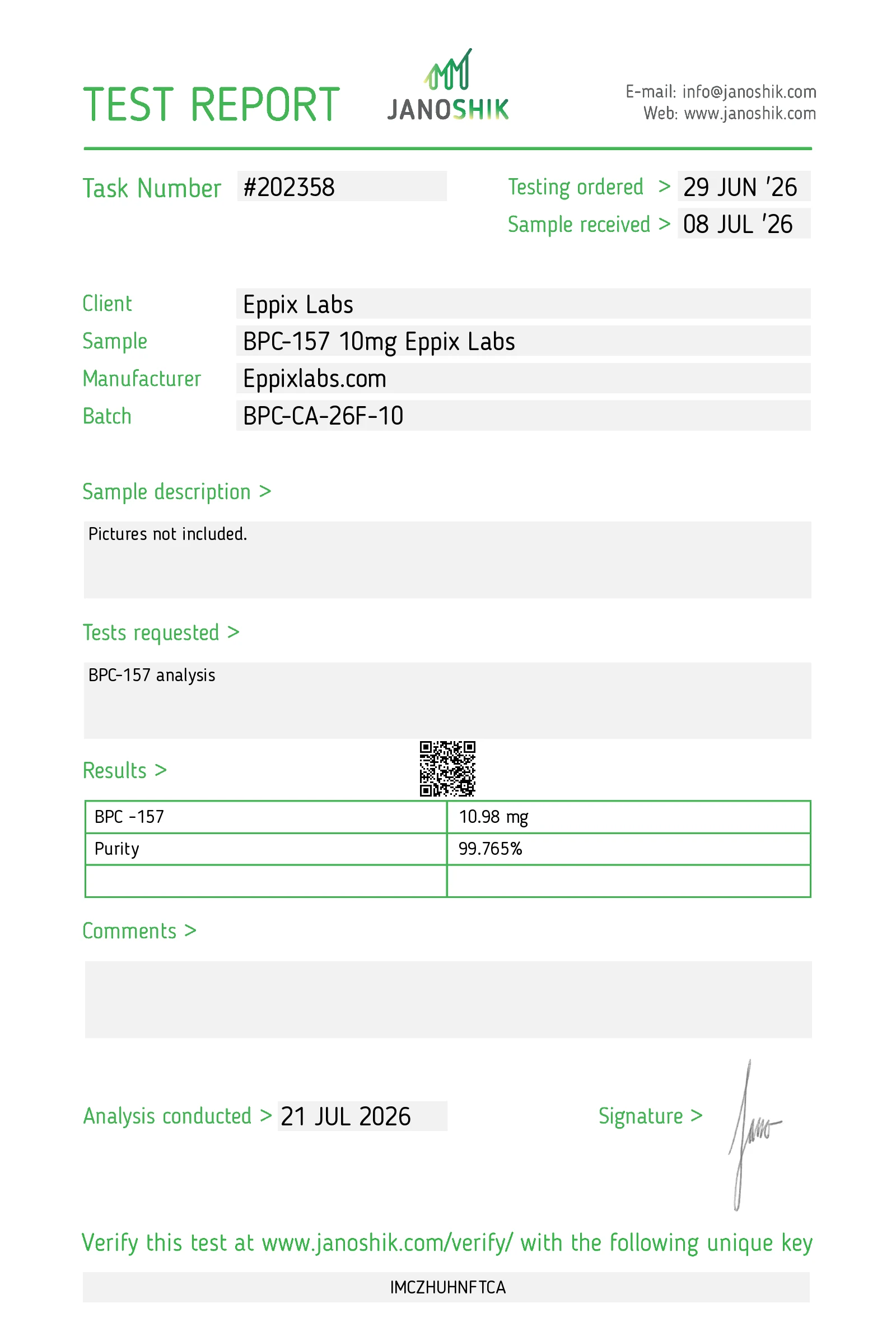
Certificate of analysis for Buy BPC-157 Canada | 10mg & 20mg Vials 10mg, batch BPC-CA-26F-10, 99.765% purity, 10.98 mg measured content

Select strength

Batch
BPC-CA-26F-10
Purity (HPLC)
99.765%
Measured content
10.98 mglabelled 10 mg
Laboratory
Janoshik
What the two-minute check is looking at.

3. Forgetting the reconstitution vehicle

Lyophilised peptide needs a solvent and it does not come in the vial. This is the single most common reason a first order arrives and then sits on a bench.

The fix: source a reconstitution vehicle before the material arrives, and get the right one. Multi-entry protocols need bacteriostatic water rather than plain sterile water, for reasons covered in the bacteriostatic water guide.

4. Guessing the reconstitution arithmetic

Concentration errors do not announce themselves. They produce results that look like a compound behaving oddly, and the error is usually found weeks later while re-reading a notebook.

The fix: use the peptide calculator to solve mass, volume and concentration, and write the result on the vial immediately. A vial with its concentration and date on the label is a vial that cannot be misremembered.

5. Shaking the vial

Peptides are chains, and shear denatures them. Vigorous shaking is the fastest way to damage material that survived synthesis, purification, lyophilisation and shipping intact.

The fix: direct the solvent down the inside wall of the vial rather than onto the cake, then swirl gently and wait. Full technique in the reconstitution guide.

6. Storing everything in the fridge door

The door is the warmest part of a refrigerator and it is temperature-cycled every time the appliance is opened. It is the worst available location for anything with a stability profile.

The fix: unreconstituted powder cool, dark and dry, with the freezer for long-term holding; reconstituted solution in the body of the refrigerator, dated. Details and the reasoning are in the peptide storage guide.

7. Ordering across the border to save a little

An inbound international parcel of research compounds is subject to customs screening, and delay or seizure are both ordinary outcomes rather than rare ones. The discount evaporates on the first parcel that does not arrive, and the foreign seller is generally under no obligation to make it good.

The fix: buy domestic stock. The arithmetic and the failure modes are set out in peptide import risks in Canada, and what domestic fulfilment actually looks like is in how we ship peptides across Canada.

8. Treating the compliance line as fine print

"Research use only" is the legal structure the entire market sits inside, not a disclaimer bolted onto the footer. A supplier that winks at it is accumulating regulatory exposure, and that exposure eventually lands on the supply chain its customers depend on.

The fix: prefer suppliers whose framing is clean, because it predicts the rest of how they operate. The regulatory position is set out in are peptides legal in Canada. This is general information and not legal advice.

Frequently Asked

What should a first order include?

The compound or compounds, a reconstitution vehicle appropriate to how many times the vial will be entered, and five minutes with the certificate before checkout.

How do I tell whether a supplier is legitimate?

External verifiability. A named testing laboratory, certificates published per lot before sale, and verification keys that resolve on that laboratory's own site rather than on the supplier's.

How fast is domestic delivery?

From Canadian stock, typically one to two business days by Canada Post Xpresspost depending on the destination, tracked throughout. City-level timings are on the city pages.

Where do I learn the terminology?

The A to Z glossary covers every term that appears on a certificate or a product page.

What is the single highest-value habit for a new buyer?

Opening the certificate once per order and checking its key at the laboratory. It takes two minutes and it is the only step in the process that cannot be faked by the supplier.

References

  1. Ashraf, A.R., Mackey, T.K., Vida, R.G. et al. (2024). Multifactor quality and safety analysis of semaglutide products sold by online sellers without a prescription: market surveillance, content analysis, and product purchase evaluation study. J Med Internet Res 26:e65440. PMID 39509151
  2. Health Canada (2026). Drug and health product compliance and enforcement: unauthorised health products and their sale in Canada. Government of Canada. Source

Research Use Only

This article summarizes published preclinical research literature. Compounds referenced are supplied by Eppix Labs strictly as research materials for laboratory investigation within Canada. They are not approved by Health Canada for human or veterinary use, and nothing on this page should be interpreted as medical advice or guidance on human or animal administration.