Canada Post Xpresspost1–2 day delivery across CanadaFree on orders over $200

Buyer Guide

Peptide Pricing in Canada: What You Are Actually Paying For

The same compound at the same strength runs at very different prices across Canadian sites. The spread is not random and it is not margin: it maps onto four real costs

·By Adam Reeves · Research Editor, Eppix Labs

Price spread confuses every new buyer in this market, because the products look identical. The same compound at the same strength can differ substantially between two Canadian sites, and the instinct is to read that as one supplier being greedy or the other being generous.

Neither is usually the explanation. Four real costs sit inside a vial, and a price is a statement about which of them were paid. Knowing them lets you read any price tag, including ours.

1. Synthesis

Cost scales with sequence length and with modifications. A three-residue compound is cheap chemistry: few coupling cycles, high crude yield, straightforward purification. A forty-plus-residue sequence is not, and a lipidated or otherwise modified compound is not, because each modification adds steps, reagents and yield loss. The mechanics are in how peptides are made.

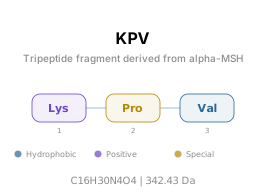
This is what accounts for most of the price differences between compounds rather than between suppliers. A price gap between KPV and cagrilintide is chemistry. A price gap between two suppliers selling the same compound is something else.
Amino Acid Sequence
Amino Acid Sequence diagram
Three residues: about two coupling cycles, and cheap to make properly.
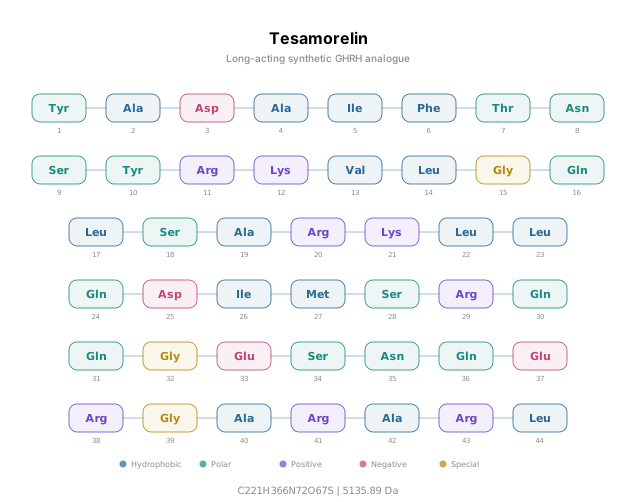
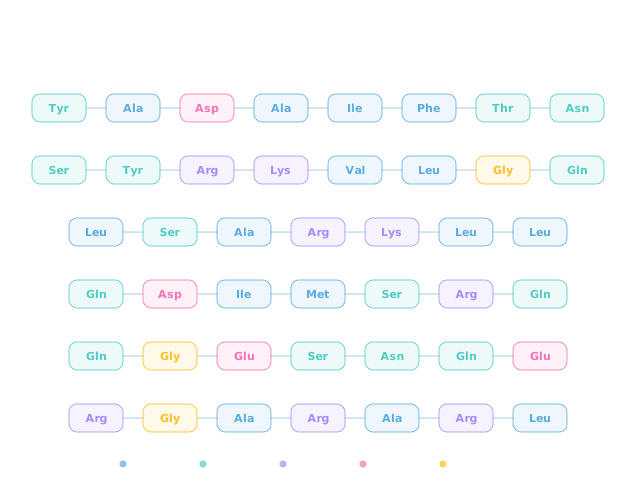
Amino Acid Sequence
Amino Acid Sequence diagram
Forty-four residues: roughly forty-three coupling cycles, lower crude yield, harder purification.

2. Purification

Taking a crude synthesis to research grade costs yield. Preparative HPLC separates the target from deletion sequences and by-products, and the collection window is a direct trade: cut it tightly for higher purity and less product, cut it generously for more product and more impurity.

A supplier that accepts a lower grade keeps the yield it would otherwise have discarded, and keeps the margin with it. Nothing about the vial reveals which choice was made. The certificate does.

3. Testing

Independent per-lot analysis, meaning purity, identity and quantified content, is a real recurring cost charged per lot rather than per year. Skipping it, testing once and reusing the document, or self-certifying are all direct savings, and all three are a transfer of risk from the supplier to the buyer.

This is the cost most easily disguised, because "third-party tested" costs nothing to write. What distinguishes a real testing programme is that the certificates are lot-specific, published before sale and checkable at the laboratory rather than only on the supplier's site.

4. Fill honesty

The quietest cost of all: actually putting the labelled quantity in the vial. Peptide is the dominant input cost, so filling short is the largest available saving with the smallest visible consequence, and it is invisible to the purity figure most buyers check. That is the subject of underfilled vials.

A price meaningfully under market where the certificate does not publish measured content is the most common shape this takes.

Reading a price that looks too good

A listing 30 to 40% under market is telling you one of the four was skipped, and it is rarely the first. Upstream synthesis chemistry is broadly similar across suppliers buying from a similar base, so the compression usually comes from purification grade, from testing, or from fill.

None of the three is visible at checkout. All three are visible on a complete, externally verifiable certificate, which is why the supplier checklist starts with certificates rather than with prices. The full version is how to choose a peptide supplier in Canada.

How this catalogue is priced

Mid-market, with the testing and the fill documented per lot rather than asserted. Multi-vial packs carry a discount because pack pricing spreads fixed handling and shipping costs rather than because the material differs, and an Interac e-Transfer discount passes back part of the difference in processing cost, which is explained in Interac e-Transfer for research orders.

Where a listing here is not the cheapest available, the certificate is the argument for the difference. That is a claim you can check rather than one you have to accept.

Frequently Asked

Why is retatrutide so much more expensive than BPC-157?

Longer, modified and harder to synthesise, with lower yields, plus demand. Chemistry difficulty predicts price far better than mechanism or popularity does.

Are expensive suppliers always honest?

No. Price alone proves nothing in either direction. Verification does, and the two-minute certificate check works the same way regardless of price tier.

Do bulk discounts compromise quality?

Not inherently. Pack pricing spreads fixed handling and shipping costs across more units. It is the same lot and the same certificate at a lower per-vial logistics cost.

Why do prices move over time?

Upstream synthesis costs and demand both shift, and the GLP-1 class moves the most of anything in the catalogue. Refreshing a quote quarterly is normal practice.

What is the cheapest thing a supplier can skip?

Fill honesty, because it saves the most and shows the least. It is also the only one of the four that a purity figure is structurally incapable of revealing.

References

  1. Behrendt, R., White, P., Offer, J. (2016). Advances in Fmoc solid-phase peptide synthesis. J Pept Sci 22(1):4-27. PMID 26785684
  2. Ashraf, A.R., Mackey, T.K., Vida, R.G. et al. (2024). Multifactor quality and safety analysis of semaglutide products sold by online sellers without a prescription: market surveillance, content analysis, and product purchase evaluation study. J Med Internet Res 26:e65440. PMID 39509151

Research Use Only

This article summarizes published preclinical research literature. Compounds referenced are supplied by Eppix Labs strictly as research materials for laboratory investigation within Canada. They are not approved by Health Canada for human or veterinary use, and nothing on this page should be interpreted as medical advice or guidance on human or animal administration.