Canada Post Xpresspost1–2 day delivery across CanadaFree on orders over $200

Verification

Why We Publish Every Certificate Before You Buy

Most suppliers treat a certificate as customer service, produced when asked. Publishing before the sale is a different thing entirely, and the difference is structural rather than cosmetic

·By Adam Reeves · Research Editor, Eppix Labs

Every supplier in this market says it tests. The interesting question is not whether testing happened but when the buyer gets to see the result, because the timing is what determines whether the supplier still has a choice about which results you see.

This page sets out why publication before the sale is the standard here, and what the alternative structurally implies. Everything described concerns laboratory research materials.

Incentives, not promises

A supplier who tests privately holds an option. Flattering results can be published and disappointing ones can be quietly withheld, and nobody outside the company ever learns that the option was exercised. That is not an accusation about any particular supplier; it is a description of what private testing leaves available.

A supplier who publishes before the sale, on a third party's verifiable system, has given that option up. The number is on the testing laboratory's database whether it flatters or not, and it is there before anyone has paid anything. Pre-sale publication is therefore not a transparency gesture. It is a commitment that makes hiding a bad lot structurally difficult, which is a stronger guarantee than any purity claim precisely because it does not require trusting the claimant.
What "every lot" actually means here

  • ·Every production lot is sampled and tested by an independent laboratory before listing: HPLC purity, mass-spectrometric identity, and measured content against the labelled amount.
  • ·The certificate goes into the public certificate archive, where it is readable without an account and without contacting anyone.
  • ·The lot code prints on every vial label, so the certificate read before payment is checkable against the vial in hand, through the verification tool and on the laboratory's own database.
  • ·Lots that do not meet standard are not listed. The archive is the record of what passed, which is a point worth stating plainly rather than implying.
Published Certificate
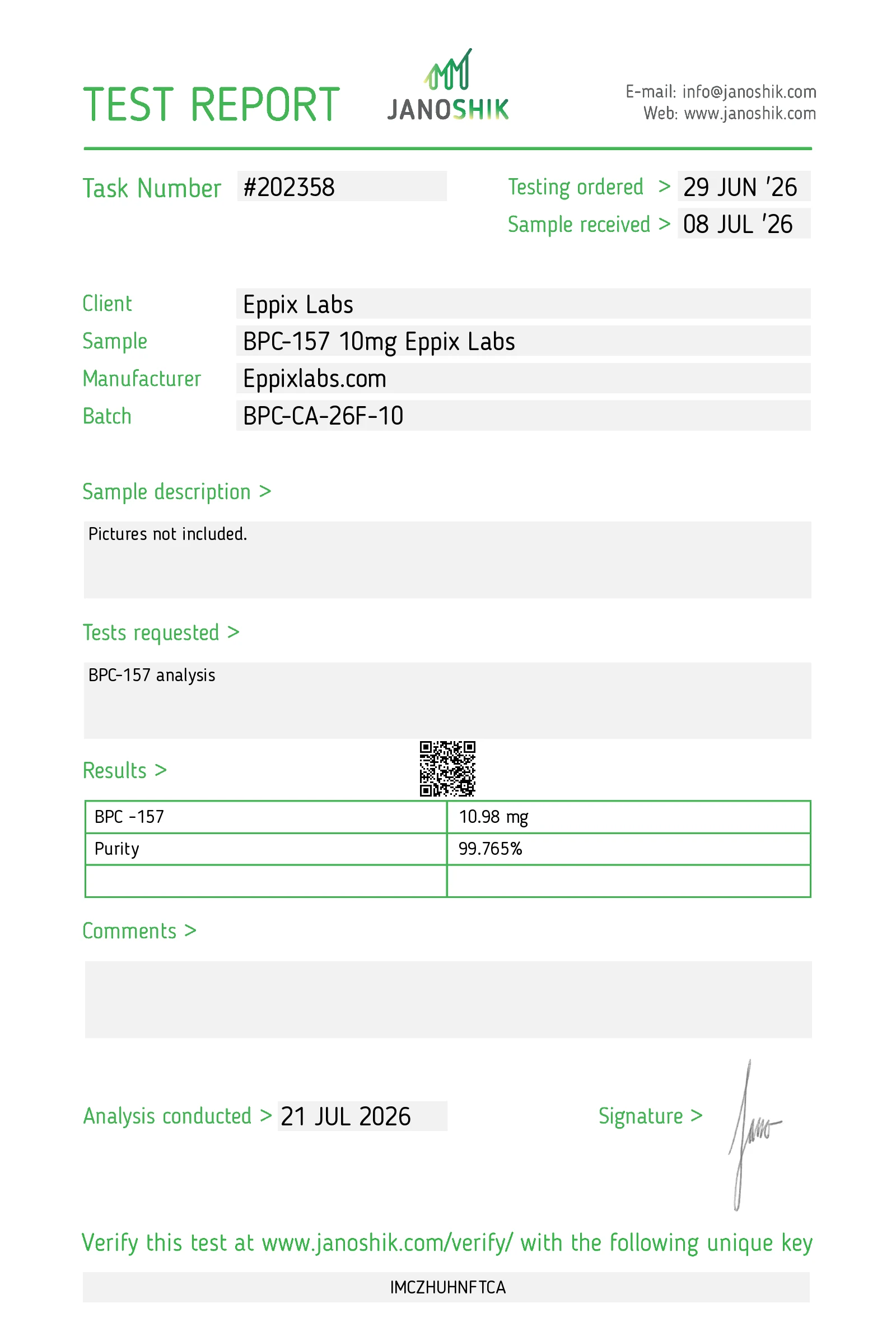
Certificate of analysis for Buy BPC-157 Canada | 10mg & 20mg Vials 10mg, batch BPC-CA-26F-10, 99.765% purity, 10.98 mg measured content

Select strength

Batch
BPC-CA-26F-10
Purity (HPLC)
99.765%
Measured content
10.98 mglabelled 10 mg
Laboratory
Janoshik
A published certificate, by strength, with the lot code that ties it to a vial.
Published Certificate
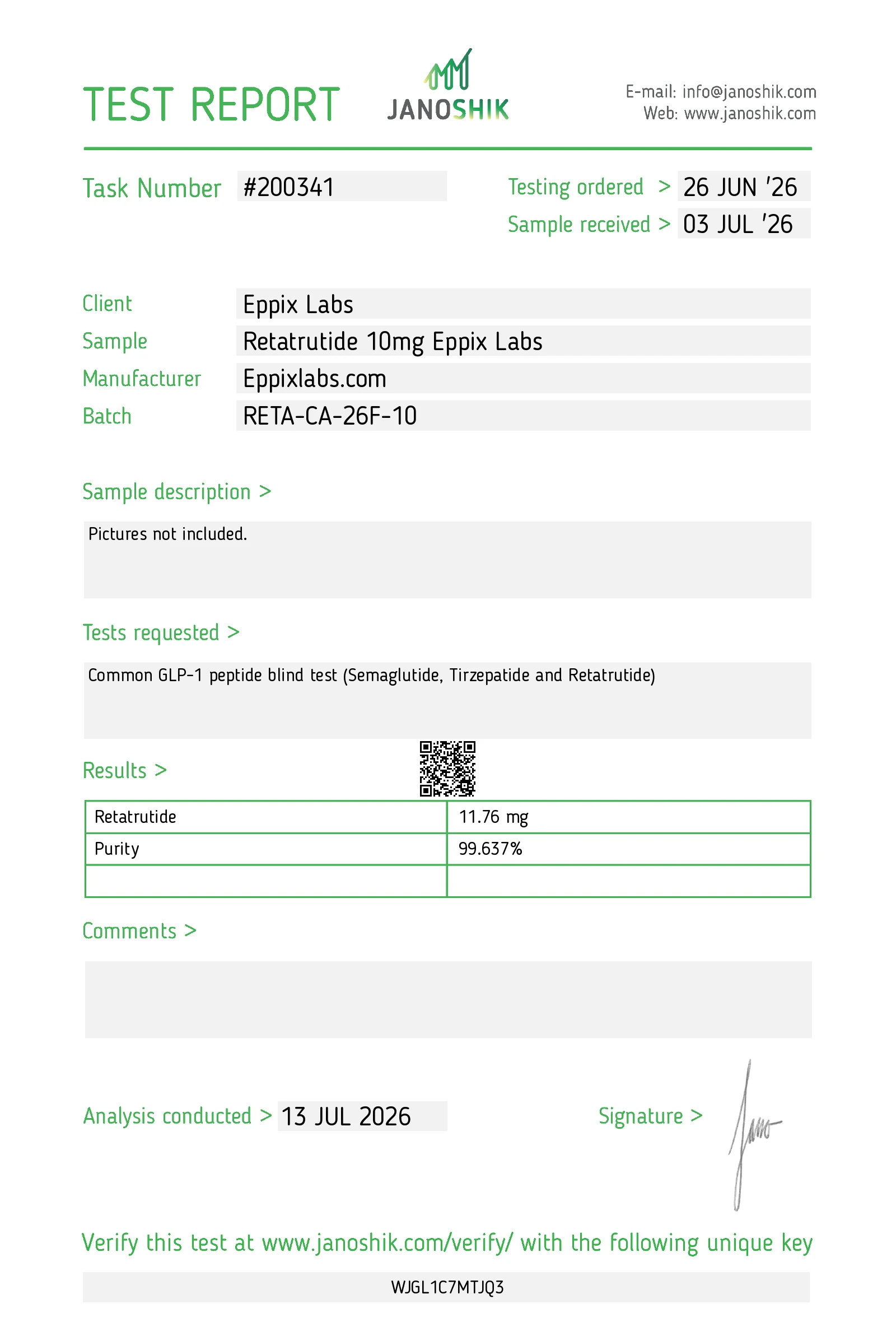
Certificate of analysis for Buy Retatrutide Canada | Triple Agonist 10mg, batch RETA-CA-26E-01, 99.637% purity, 11.76 mg measured content

Select strength

Batch
RETA-CA-26E-01
Purity (HPLC)
99.637%
Measured content
11.76 mglabelled 10 mg
Laboratory
Janoshik
The same standard applied to a compound where counterfeiting is the market norm.

What "COA on request" tells you

Sometimes it is just habit, inherited from a period when nobody published anything. Structurally, though, on-request means three things at once: the supplier chooses which document you see, you see it after demonstrating purchase intent, and it arrives in a format you cannot independently check.

Every red flag catalogued in how to spot a fake COA lives in that gap. So the useful question to put to any supplier is not "do you have certificates", because everyone says yes. It is "why is the certificate for the exact lot I would receive not already public".

The scale of what that gap conceals is documented. Market-surveillance work on peptide products sold online without prescription has found products failing on content and on identity, which is the outcome a private-testing regime is structurally unable to prevent.[1]

Verification instead of reputation

The point of the system is that you should not have to trust us. Read the certificate, check its key on the testing laboratory's own site, then decide. Nothing in that sequence depends on our word, and that is deliberate.

Reputation is a lagging indicator in a market where the failure mode is invisible: a short-filled vial produces weaker results, and researchers blame the compound rather than the supplier. Verification is the only standard that survives those incentives, and it is the one worth competing on.

Frequently Asked

Where do I find a product's current lot certificate?

Linked on every product page, and in the certificate archive by lot code. No account and no contact with support is required.

What if my vial's lot differs from the page?

It should not: listings are tied to the shipping lot, and when stock rotates the certificate rotates with it. If a lot code does not resolve, that is worth reporting rather than assuming.

Has a lot ever failed?

Lots below standard are not listed, so the public archive is the record of what passed rather than a record of everything ever tested. Saying so plainly is more useful than implying a perfect record.

Can other suppliers' certificates be checked the same way?

Only if the laboratory offers public verification and the supplier publishes lot-specific certificates. Where both are true, the same two-minute check works on anyone.

Why does publishing before the sale matter more than publishing at all?

Because a document produced after a purchase decision cannot influence that decision, and because a supplier that publishes only on request retains the ability to choose what gets published.

References

  1. Ashraf, A.R., Mackey, T.K., Vida, R.G. et al. (2024). Multifactor quality and safety analysis of semaglutide products sold by online sellers without a prescription: market surveillance, content analysis, and product purchase evaluation study. J Med Internet Res 26:e65440. PMID 39509151
  2. Health Canada (2026). Drug and health product compliance and enforcement: unauthorised health products and their sale in Canada. Government of Canada. Source

Research Use Only

This article summarizes published preclinical research literature. Compounds referenced are supplied by Eppix Labs strictly as research materials for laboratory investigation within Canada. They are not approved by Health Canada for human or veterinary use, and nothing on this page should be interpreted as medical advice or guidance on human or animal administration.