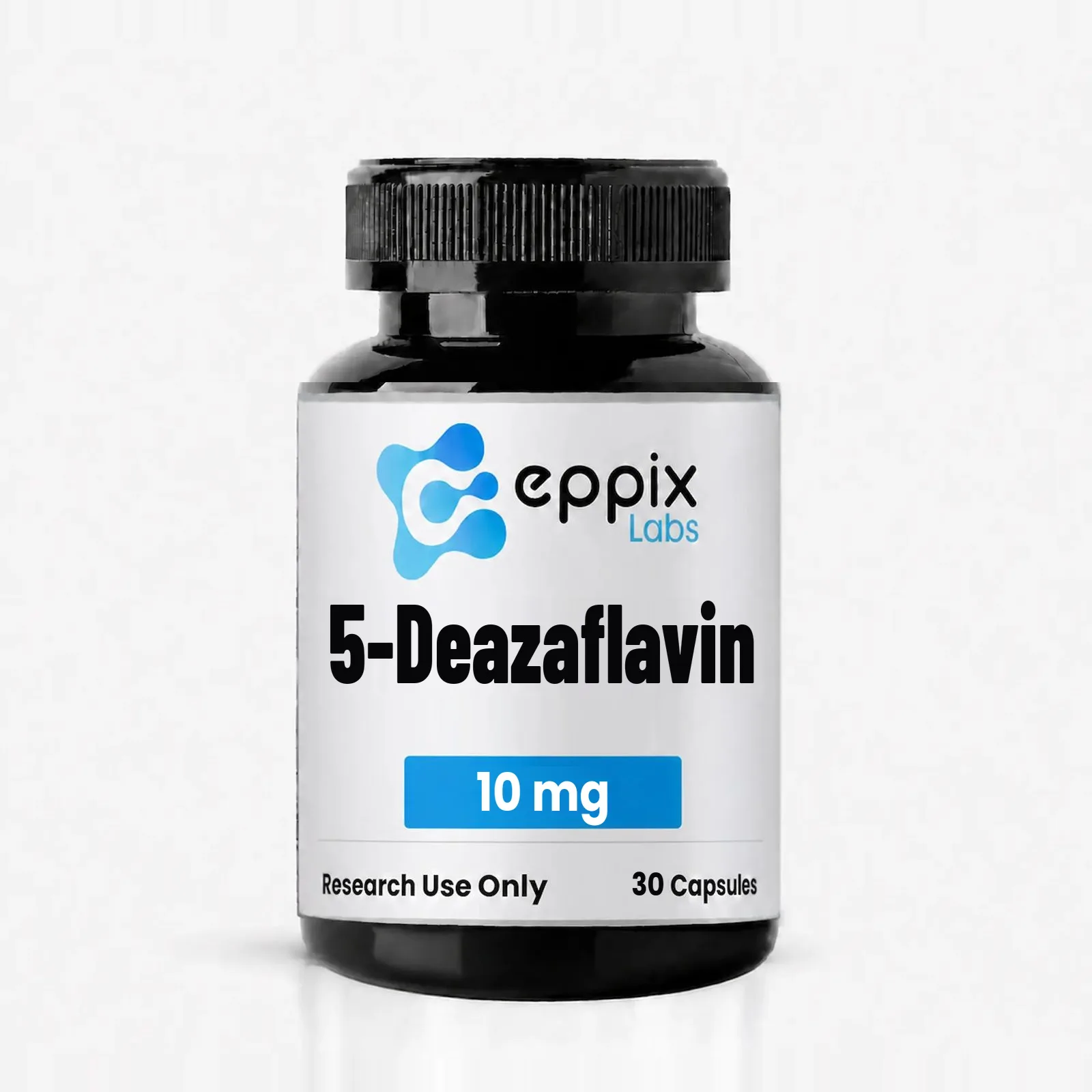
5-Deazaflavin is a synthetic analogue of the flavin ring system in which the nitrogen at position 5 of the isoalloxazine core is replaced by carbon. That single substitution changes the electronic behaviour of the ring, and the compound has been used in chemistry and biochemistry as a comparison point against natural flavin cofactors.
$20.97$29.95Eppix Flash Sale −30%CAD
⚡ Flash sale −30%Ends in 00:00:00Applied automatically at checkout
Purity VerifiedLab TestedSecure
Research Use Only
This product is intended strictly for laboratory research use within Canada. It is not approved by Health Canada for the diagnosis, treatment, cure, or prevention of any disease. Not for human or veterinary use.
By purchasing, you confirm the material will be used solely for lawful research purposes in accordance with applicable Canadian regulations.
5-Deazaflavin is a synthetic analogue of the flavin ring system in which the nitrogen at position 5 of the isoalloxazine core is replaced by carbon. That single substitution changes the electronic behaviour of the ring, and the compound has been used in chemistry and biochemistry as a comparison point against natural flavin cofactors.
In scientific literature, 5-deazaflavin and its derivatives appear in studies of redox biocatalysis, radical intermediates, photochemical electron transfer, deazaflavin cofactor biosynthesis in microorganisms, and as a chemical scaffold for synthetic derivative series evaluated in enzyme and cell-based assays.
Purity
Third-party tested for purity, ID, quantity.
Coming Soon
The certificate of analysis for this lot is being finalised and will be published here as soon as the lab returns it.
The defining feature of 5-deazaflavin is that replacing N5 with carbon shifts the ring from the one-electron redox chemistry characteristic of natural flavins toward hydride-transfer behaviour more comparable to nicotinamide cofactors. Comparative chemical evaluations of flavin and 5-deazaflavin in modified flavoproteins established this distinction as a probe for the mechanism of redox biocatalysis. Subsequent spectroscopic work characterised the 5-deazaflavin radical and compared its structure and properties to natural flavosemiquinones, and photochemically induced dynamic nuclear polarization has been used to provide evidence of radical formation under photochemical conditions. A related analogue, 5-thia-5-deazaflavin, was described as a one-electron transferring flavin analogue.
Research endpoints across the record are varied. In microbial biochemistry, 8-hydroxy-5-deazaflavin functions as a cofactor, with analogue series evaluated as substrates for a deazaflavin-dependent NADP+ reductase, and the compound class features in reviews of formate dehydrogenase and in mechanistic work on radical-mediated deazaflavin biosynthesis. In synthetic chemistry, C5-substituted 5-deazaflavins have been examined as photosensitizers for dehalogenation of aryl halides. Derivative series built on the scaffold have been reported as inhibitors of p53 ubiquitination by HDM2, as sialic acid conjugates and as kinase-screened compounds in antitumor assay panels, and bis(tetrahydro-5-deazaflavin) analogues have been studied for DNA photocleavage and DNA/protein binding. Separately, the 5-deazaflavin derivative TND1128 has been examined in mouse brain slice preparations for effects on mitochondrial membrane potential and ATP synthesis, with one report comparing it against β-NMN.
History
5-Deazaflavin entered the literature in the 1970s as a deliberately modified cofactor analogue used to interrogate how flavoproteins carry out redox catalysis. Chemical evaluations published in that period framed it as a tool for distinguishing one-electron from two-electron pathways, and follow-on work in the late 1970s and early 1980s characterised related analogues and the spectroscopic properties of the deazaflavin radical.
A parallel line developed in microbial biochemistry, where hydroxylated deazaflavin species were identified as naturally occurring cofactors and studied in methanogen enzyme systems and in later work on deazaflavin biosynthesis. From the 2000s onward the ring system was increasingly treated as a synthetic scaffold, with derivative series reported in enzyme inhibition, nucleic acid interaction, photocatalysis and mitochondrial research contexts. Much of the recent biological literature concerns specific derivatives rather than the parent compound itself.
Key Research Areas
Laboratory work involving 5-deazaflavin spans mechanistic redox biochemistry, radical spectroscopy, microbial cofactor enzymology, photocatalytic chemistry, and derivative-based screening. Research frameworks typically use the compound either as a mechanistic probe against natural flavins or as a core structure for synthetic analogue series evaluated in in vitro enzyme, DNA-binding, photochemical and tissue-preparation assays.
4 of the 5 areas below are addressed directly by a paper cited on this page.
Flavin analogue redox mechanism studies
Addressed on this page by Hemmerich 1977, Yamazaki 1982, Takahashi 2023. Each is linked to its source record in the references below, so what was measured — and in what system — can be read rather than taken on trust.
Hemmerich, P. et al. (1977) — Flavin and 5-deazaflavin: a chemical evaluation of 'modified' flavoproteins with respect to the mechanisms of redox biocatalysis
Yamazaki, S. et al. (1982) — Analogues of 8-hydroxy-5-deazaflavin cofactor: relative activity as substrates for 8-hydroxy-5-deazaflavin-dependent NADP+ reductase from Methanococcus vannielii
Takahashi, N. et al. (2023) — Effects of TND1128 (a 5-deazaflavin derivative), with self-redox ability, as a mitochondria activator on the mouse brain slice and its comparison with β-NMN
Radical and semiquinone spectroscopy
Addressed on this page by Goldberg 1981, Wörner 2023. Each is linked to its source record in the references below, so what was measured — and in what system — can be read rather than taken on trust.
Goldberg, M. et al. (1981) — Structure and properties of 5-deazaflavin radicals as compared to natural flavosemiquinones
Wörner, J. et al. (2023) — Expanding Reaction Horizons: Evidence of the 5-Deazaflavin Radical Through Photochemically Induced Dynamic Nuclear Polarization
Deazaflavin cofactor enzymology in microorganisms
Addressed on this page by Yamazaki 1982, Hemmerich 1977, Goldberg 1981. Each is linked to its source record in the references below, so what was measured — and in what system — can be read rather than taken on trust.
Yamazaki, S. et al. (1982) — Analogues of 8-hydroxy-5-deazaflavin cofactor: relative activity as substrates for 8-hydroxy-5-deazaflavin-dependent NADP+ reductase from Methanococcus vannielii
Hemmerich, P. et al. (1977) — Flavin and 5-deazaflavin: a chemical evaluation of 'modified' flavoproteins with respect to the mechanisms of redox biocatalysis
Goldberg, M. et al. (1981) — Structure and properties of 5-deazaflavin radicals as compared to natural flavosemiquinones
Photosensitizer and photocatalysis chemistry
No paper cited on this page reports on photosensitizer, photocatalysis or chemistry. This heading marks where 5-Deazaflavin Capsules is discussed in the category rather than a question the cited literature answers, and it is worth knowing which of these areas has work behind it and which does not.
Derivative scaffolds in enzyme inhibition screening
Addressed on this page by Dickens 2013, Takahashi 2023. Each is linked to its source record in the references below, so what was measured — and in what system — can be read rather than taken on trust.
Takahashi, N. et al. (2023) — Effects of TND1128 (a 5-deazaflavin derivative), with self-redox ability, as a mitochondria activator on the mouse brain slice and its comparison with β-NMN
The references section of this page cites 6 primary papers published between 1977 and 2023 — a limited but non-trivial record. Every citation is linked to its PubMed or DOI record so it can be read rather than taken on trust, and the summaries above describe what those papers report rather than what the compound is claimed to do.
5-Deazaflavin Capsules is frequently listed as a peptide by suppliers in this market. It is not one. The structure published on this page is the compound's actual chemistry, and research on it should be read against its own class rather than against peptide literature.
Research compounds attract claims that outrun their evidence. Below are the ones most often encountered for 5-Deazaflavin Capsules, set against what the papers cited on this page actually report. Where the record is thin or contested, that is stated rather than smoothed over.
Preclinical only
5-Deazaflavin Capsules is commonly described online in connection with faster healing from injury and improved recovery. In the research literature the same compound is filed under flavin analogue redox mechanism studies, radical and semiquinone spectroscopy and deazaflavin cofactor enzymology in microorganisms.
The 6 papers cited on this page, published between 1977 and 2023 (1 in animal models) describe laboratory and animal work. None reports a controlled trial in humans. Findings in cell culture or in a rodent model describe what happened in that system; they do not establish that the same occurs in humans, and this compound is not approved for human use.
Nothing above is a statement of what this material does. It is a summary of what has been published and what has not. Eppix Labs supplies research materials only and provides no dosing, administration or protocol guidance.
Verification for 5-Deazaflavin Capsules is per lot, not per product. The current lot DEAZ-CA-26I-01 returned 7.14 mg measured, assayed by Janoshik. Those figures are the laboratory's, published in full rather than reduced to a badge.
The lot code printed on the bottle matches the code on the certificate for 5-Deazaflavin Capsules. Matching the two is what confirms the unit in hand came from the batch that was tested — a certificate not tied to a lot code proves nothing about any particular unit.
Researchers who buy 5-Deazaflavin Capsules in Canada through Eppix Labs receive the lot described by the certificate above: the code printed on the vial label is the code on the certificate, and both are searchable on the batch verification page.
5-Deazaflavin Capsules is supplied in capsule form, which removes the reconstitution step entirely: there is no vehicle to add, no reconstitution volume to record and no post-reconstitution stability window to track. What that leaves a laboratory to control is storage — capsule shells draw moisture from the air, so the container should be kept sealed and dry rather than decanted into an open vessel.
Because the material is already at its labelled quantity per capsule, batch verification carries more weight in this format than it does for powder: there is no point at which the researcher independently confirms mass by weighing. The measured content published for each lot is the figure that answers that question.
1 × sealed capsule bottle (10mg per capsule / Single Bottle - Pack of 30), batch-labelled
Batch documentation for the lot shipped, once its certificate is published
Discreet outer packaging with no product names on the exterior
Canada Post Xpresspost, tracked, typically 1–2 business days from Canadian stock
Not included
Laboratory consumables of any kind
Dosing, administration or protocol guidance of any kind
No. Eppix Labs products are supplied exclusively for laboratory research. We do not provide dosing, administration, or usage guidance.
Each unit contains the labeled quantity of 5-deazaflavin. Independent third-party analysis verifies purity, identity, and net content per batch.
The unit contains only the compound. Any solvents, glassware or other laboratory materials required for experimental procedures must be sourced separately.
Duration depends entirely on research design, storage conditions, and laboratory protocol.
Hemmerich, P. et al.(1977)
Flavin and 5-deazaflavin: a chemical evaluation of 'modified' flavoproteins with respect to the mechanisms of redox biocatalysis
Analogues of 8-hydroxy-5-deazaflavin cofactor: relative activity as substrates for 8-hydroxy-5-deazaflavin-dependent NADP+ reductase from Methanococcus vannielii
Effects of TND1128 (a 5-deazaflavin derivative), with self-redox ability, as a mitochondria activator on the mouse brain slice and its comparison with β-NMN
PDE5 Inhibitor Research Compound
Tadalafil is a small-molecule phosphodiesterase type 5 (PDE5) inhibitor supplied in capsule form for laboratory research. It is handled as a reference compound in controlled experimental and analytical settings.
AMPA Receptor Potentiator
TAK-653 is a small molecule described in the literature as an AMPA receptor positive allosteric modulator. It is supplied in capsule form strictly for laboratory research use.
Unidentified Capsule Preparation
SANA Capsules is supplied as a capsule-format research item. No molecular identity, sequence, or defined active constituent could be established for this designation from the available chemical records or published literature.
Oral Non-Peptide GLP-1 Receptor Agonist
Orforglipron is an orally available, non-peptide small molecule characterised as an agonist at the glucagon-like peptide-1 (GLP-1) receptor. It is supplied here in capsule form for laboratory research within controlled experimental environments.
$52.46$74.95CAD
⚡Flash sale ends in 0h 00m
Support
Need help?
Have questions about batch verification, documentation, or research specifications? Our team is available to assist with product and compliance inquiries.


 Eppix Flash Sale −30%