Canada Post Xpress1–2 day delivery across CanadaFree on orders over $200

Sourcing Guide

Ipamorelin in Canada: The Selective Secretagogue

A pentapeptide whose defining property is what it does not do, and a certificate check that suits a small molecule

·Compiled by Eppix Labs

Ipamorelin is defined in the literature by a negative result, which is unusual and worth taking seriously. Raun et al. (1998) characterized it as the first selective growth hormone secretagogue: it released GH in their models without the prolactin and ACTH elevation that accompanied earlier compounds in the class.[1] Selectivity, not potency, is the property the paper is about.

This guide covers the molecule, the published work, and the certificate checks. Ipamorelin is supplied for laboratory research use only.

Chemical Identity

Name
Ipamorelin
Also known as
Ipamorelin, NNC 26-0161
Molecular formula
C₃₈H₄₉N₉O₅
Molecular weight
711.85 g/mol
CAS number
170851-70-4
Sequence (1-letter)
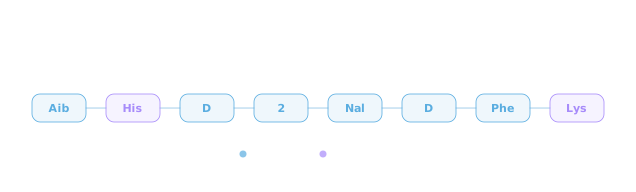
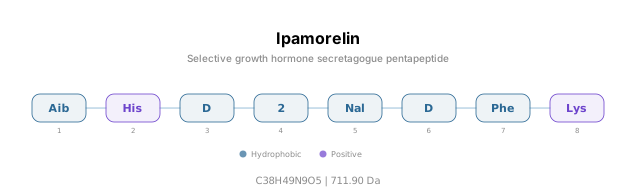
Aib-His-D-2-Nal-D-Phe-Lys-NH2
Sequence (3-letter)
Aib-His-D-2-Nal-D-Phe-Lys
Salt forms
Acetate

What ipamorelin is

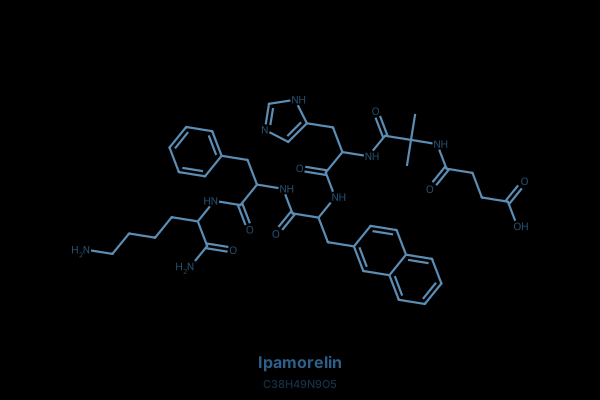
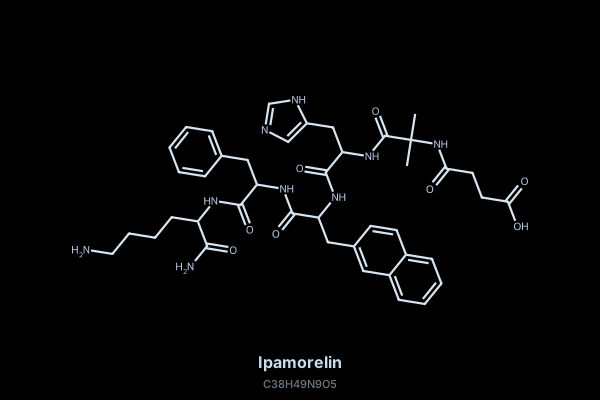
Ipamorelin is a synthetic pentapeptide agonist at the growth hormone secretagogue receptor GHS-R1a, the same receptor ghrelin acts on. Two of its five residues are non-natural (α-aminoisobutyric acid at position 1, D-2-naphthylalanine at position 3), one more is a D-amino acid, and the C-terminus is amidated. Those modifications are what give a five-residue peptide enough metabolic stability to be useful.

Mechanistically it sits on the opposite side of the GH axis from the GHRH analogues: CJC-1295, sermorelin and tesamorelin act at the GHRH receptor, ipamorelin at the ghrelin receptor. That is why the two classes are studied together, and why they are sold together.
Research Material
General Image
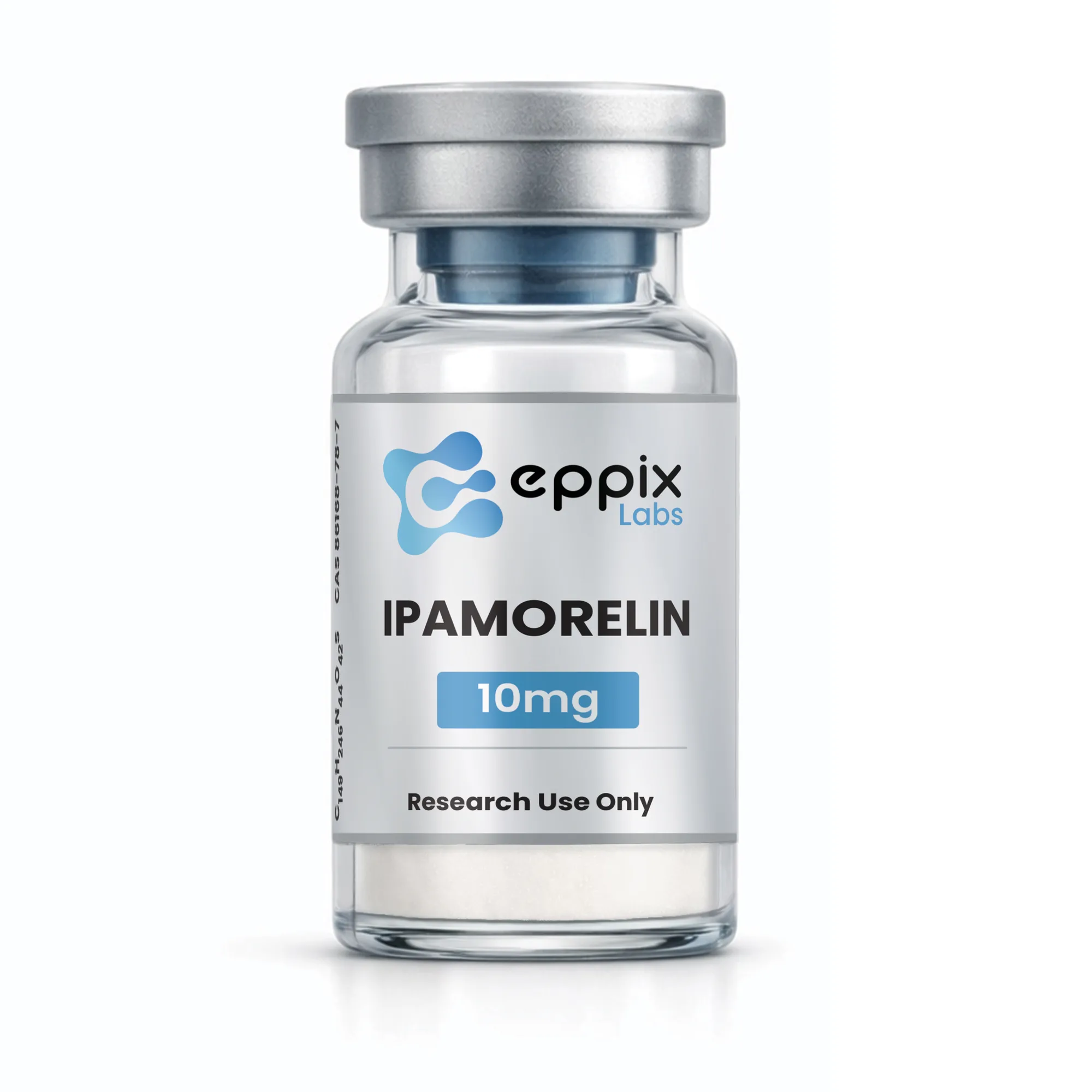
Ipamorelin lyophilized research material as supplied by Eppix Labs. Labelled and measured content are stated on the certificate below.

Sequence and structure

Five residues, around 712 Da, with three non-standard positions. The non-natural residues are the quality-relevant detail: a supplier substituting L-phenylalanine for D-phenylalanine, or plain alanine for Aib, produces a peptide with a different mass and different behaviour that a purity assay would happily report as pure. Identity by mass spectrometry is the check that catches it.

Amino Acid Sequence
Amino Acid Sequence diagram
Amino-acid sequence of ipamorelin.
Chemical Structure
Chemical Structure diagram
Chemical structure of ipamorelin, C₃₈H₄₉N₉O₅.

What the published research shows

A small, coherent literature centred on the original development programme:

  • ·Characterization and selectivity. Raun et al. (1998): GH release in rat and swine models with the selectivity profile that gave the compound its name in the literature.[1]
  • ·Longitudinal bone growth. Johansen et al. (1999) reported increased longitudinal bone growth in rats on repeated administration.[2]
  • ·Glucocorticoid-induced bone loss. Andersen et al. (2001) reported that ipamorelin counteracted glucocorticoid-induced decrease in bone formation in adult rats.[3]

The limit of the evidence

Ipamorelin entered early clinical investigation and was not carried through development. There are no published randomised efficacy trials, no approved indication in any jurisdiction, no established human dose, and no human safety record of meaningful size. Health Canada has authorized nothing containing it.

The selectivity result is a preclinical finding in specific animal models. It is frequently repeated as though it were a human clinical characterization, which it is not.

Verifying an ipamorelin lot

Identity by mass spectrometry against the expected mass near 712 Da, HPLC purity, and measured content against the labelled amount. For a peptide this small, measured content is the figure that most directly affects what you paid for: a 10 mg label with 6 mg in the vial is a 40% loss that purity data cannot reveal.

Every Eppix ipamorelin lot is tested by Janoshik Analytical, published before sale and verifiable on the laboratory's own database.

Published Certificate
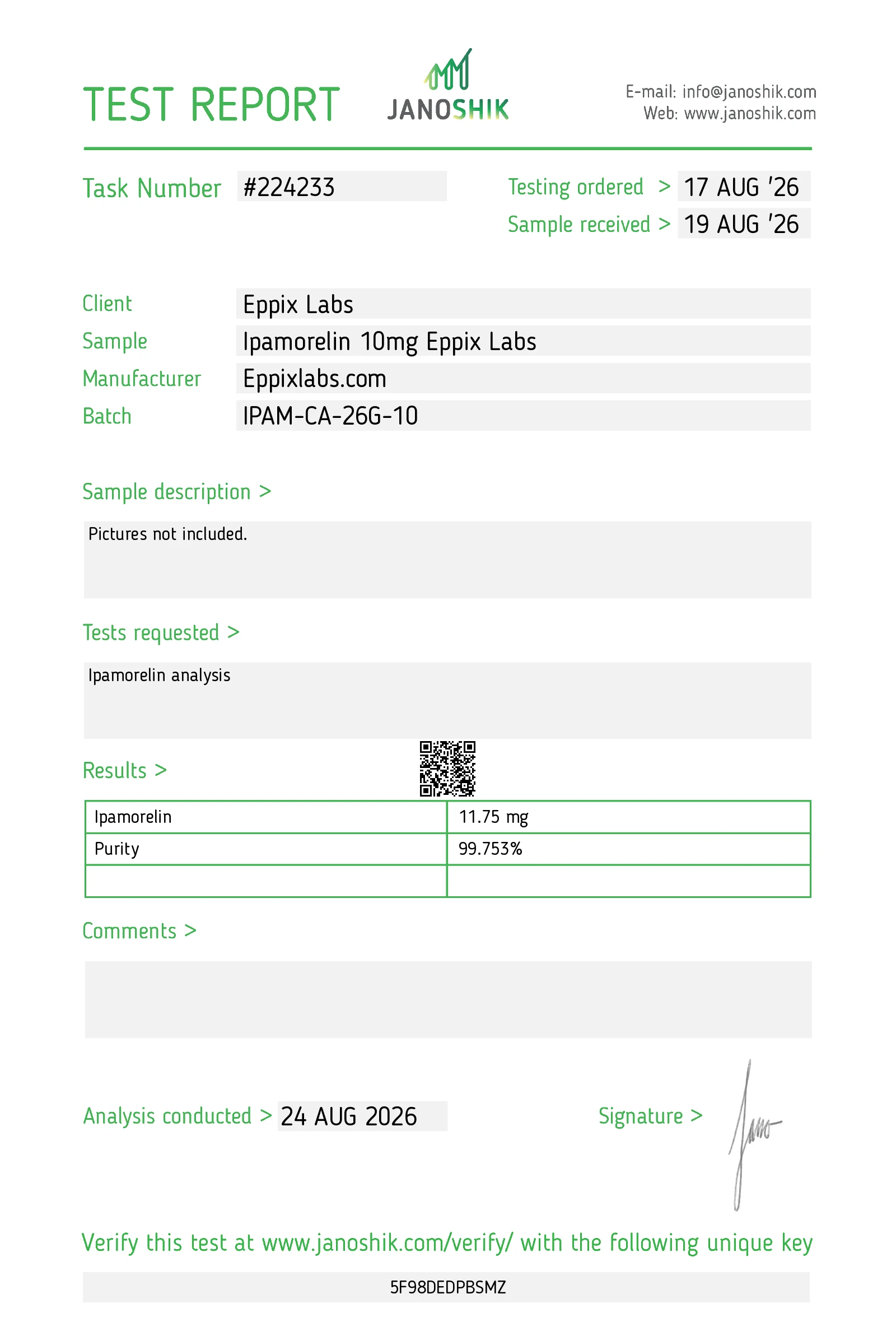
Certificate of analysis for Buy Ipamorelin Canada | GH Secretagogue 10mg 10mg, batch IPAM-CA-26G-10, 99.753% purity, 11.75 mg measured content
Batch
IPAM-CA-26G-10
Purity (HPLC)
99.753%
Measured content
11.75 mglabelled 10 mg
Laboratory
Janoshik
Published certificate for the current ipamorelin lot, read live from the batch record.

Sourcing in Canada

Domestic fulfilment is by Canada Post Xpresspost, typically one to two days nationwide, free over $200, with an Interac e-Transfer discount and mix-and-match pricing at 5 and 10 vials.

Ipamorelin is also supplied blended with CJC-1295; that pairing, and how to read a blend certificate, is covered at buy CJC-1295 and ipamorelin in Canada.

Frequently Asked

What makes ipamorelin "selective"?

In the 1998 characterization, it released GH in animal models without the prolactin and ACTH elevation that accompanied earlier growth hormone secretagogues. Selectivity in this sense refers to that preclinical finding, not to a human clinical characterization.

Is ipamorelin legal in Canada?

It may be sold and held as a laboratory research material. It is not authorized by Health Canada for human or veterinary use. This is not legal advice.

How does ipamorelin differ from CJC-1295?

Different receptors. Ipamorelin agonizes the ghrelin receptor GHS-R1a; CJC-1295 is a GHRH-receptor analogue. They are studied and sold together because they engage the same axis from two directions.

What should an ipamorelin certificate show?

Batch number matching the vial, the named testing laboratory with an independent verification path, MS identity against the expected mass near 712 Da, HPLC purity, and measured content against the labelled amount.

Are there human trials of ipamorelin?

It entered early clinical investigation and was not developed further. There are no published randomised efficacy trials and no approved indication anywhere.

How is ipamorelin stored?

Lyophilized: cool, dry, dark, at -20 °C for long-term storage. Reconstituted: refrigerated, used within the window your protocol defines.

References

  1. Raun, K. et al. (1998). Ipamorelin, the first selective growth hormone secretagogue. Eur J Endocrinol 139(5):552-561. PMID 9849822
  2. Johansen, P.B. et al. (1999). Ipamorelin, a new growth-hormone-releasing peptide, induces longitudinal bone growth in rats. Growth Horm IGF Res 9(2):106-113. PMID 10373343
  3. Andersen, N.B. et al. (2001). The growth hormone secretagogue ipamorelin counteracts glucocorticoid-induced decrease in bone formation of adult rats. Growth Horm IGF Res 11(5):266-272. PMID 11735244

Research Use Only

This article summarizes published preclinical research literature. Compounds referenced are supplied by Eppix Labs strictly as research materials for laboratory investigation within Canada. They are not approved by Health Canada for human or veterinary use, and nothing on this page should be interpreted as medical advice or guidance on human or animal administration.