Canada Post Xpress1–2 day delivery across CanadaFree on orders over $200

Sourcing Guide

Eloralintide in Canada: The Selective Amylin Agonist

The newest compound on the metabolic shelf, with a short but genuinely peer-reviewed public record

·Compiled by Eppix Labs

Eloralintide is the frontier edge of the metabolic catalogue: a compound most of the market had not heard of eighteen months ago, now in demand because amylin biology is the field's next act. Frontier compounds carry frontier risks, namely thin public information, no track record, and a supply chain sprinting to meet demand.

What has changed since the first wave of coverage is that eloralintide now has real peer-reviewed publications behind it: a phase 1 proof-of-concept paper, a 48-week phase 2 trial in the Lancet, and a discovery-to-clinic paper in Molecular Metabolism. Here is what is actually known, and how to buy without guessing. Eloralintide is an investigational compound supplied for laboratory research use only.

Chemical Identity

Name
Eloralintide (LY3841136)
Also known as
Eloralintide, LY3841136
Molecular formula
Not publicly disclosed
Molecular weight
Not publicly disclosed
CAS number
2891585-92-9
Salt forms
Acetate (research supply)

What eloralintide is

Eloralintide, development code LY3841136, is a synthetic peptide developed by Eli Lilly as a long-acting, selective amylin receptor agonist. Amylin, the pancreatic hormone co-secreted with insulin, signals satiety and slows gastric emptying, and its receptors are complexes of the calcitonin receptor with RAMP subunits.[3]

The design goal, stated in the discovery paper, is selective engagement of the amylin receptor complexes, which distinguishes it from earlier analogues whose activity extends across the calcitonin receptor family. For a researcher, selectivity is the point: it is the tool compound for isolating amylin-receptor signaling without confounding pharmacology.

The full sequence and molecular formula have not been placed in the public domain, which is normal for a compound at this stage and is worth stating plainly rather than filling in with a guess.
Research Material
General Image
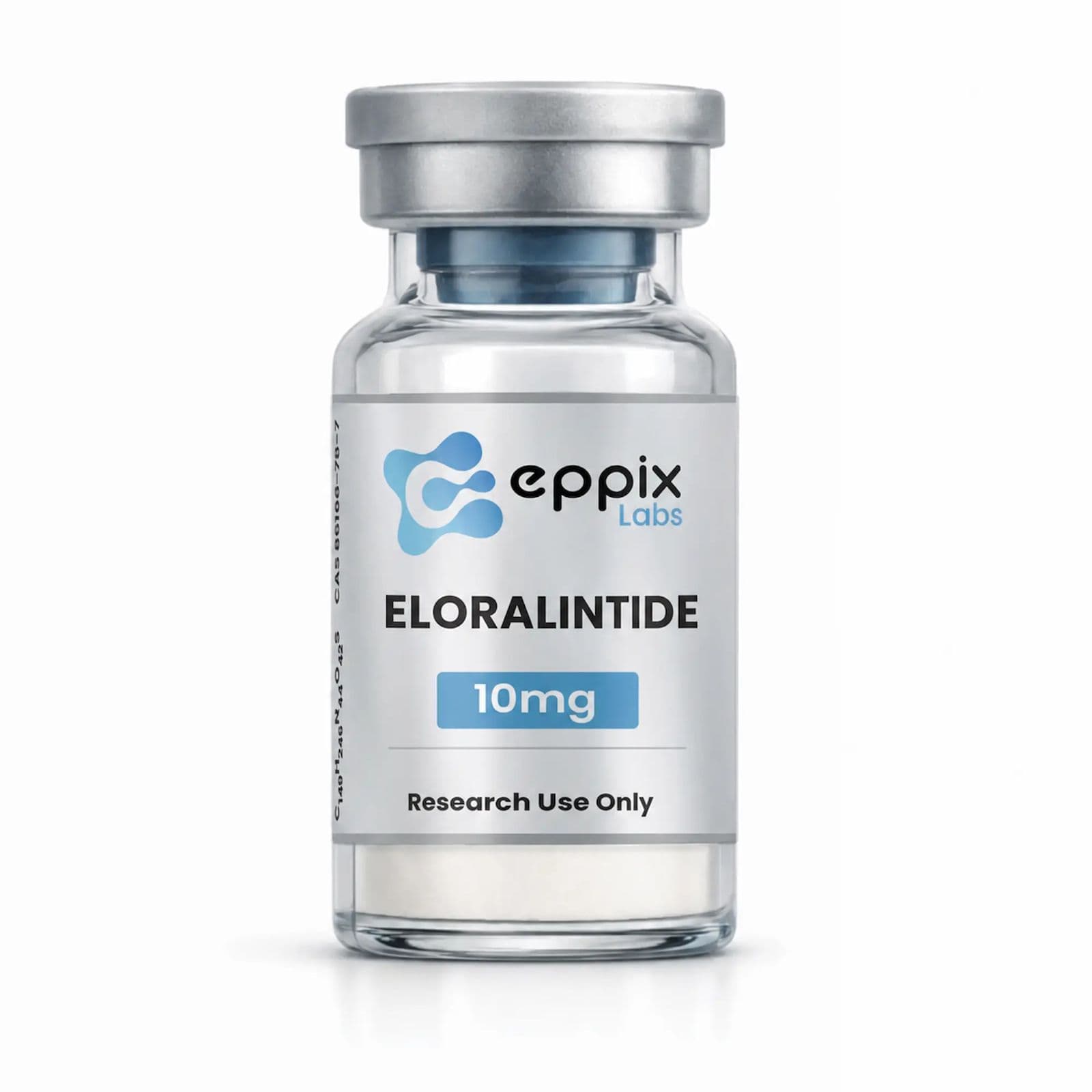
Eloralintide lyophilized research material as supplied by Eppix Labs. Labelled and measured content are stated on the certificate below.

What the published trials reported

The public record is short and can be read in an afternoon, which is exactly why it is worth reading rather than summarising from secondary sources:

  • ·Phase 2, obesity. Billings et al., Lancet 2025: a 48-week multicentre, double-blind, randomised, placebo-controlled trial in adults with obesity or overweight. All treatment arms met the primary endpoint, with mean weight reductions reported from roughly 9.5% to 20.1% against 0.4% for placebo. The most common adverse events were mild to moderate nausea and fatigue.[1]
  • ·Phase 1, proof of concept. Bhattachar et al., Diabetes, Obesity and Metabolism 2026: the first-in-human pharmacokinetic and pharmacodynamic characterization supporting once-weekly administration.[2]
  • ·Discovery to clinic. The Molecular Metabolism paper covering receptor pharmacology, selectivity profiling and the preclinical package behind the clinical programme.[3]

The limit of the evidence, stated plainly

That is the entire public record. No approval in any jurisdiction, no completed phase 3 dataset, no long-term human safety data. Phase 3 design work was reported as underway during 2026. Anyone writing confident long-term outcome claims about eloralintide is writing fiction.

For a researcher, the thinness of the record is the compound's value rather than its drawback: it is a selective tool for isolating amylin-receptor effects, adjacent to but cleaner than earlier dual-pharmacology analogues. It is not a validated intervention, and it is not authorized for human use anywhere.

Eloralintide against cagrilintide

The two are the reference points for each other, and the differences are real rather than positional:

  • ·Developer. Eloralintide is Eli Lilly; cagrilintide is Novo Nordisk. The programmes are independent.
  • ·Pharmacology. Eloralintide is engineered for amylin-receptor selectivity. Cagrilintide is a long-acting amylin analogue with a broader profile across the calcitonin receptor family.
  • ·Development stage. Eloralintide has published phase 1 and phase 2 results. Cagrilintide has phase 2 monotherapy data and late-stage combination work.
  • ·Public data volume. Cagrilintide substantially more, including combination trials. Eloralintide limited but peer-reviewed.
Chemical Structure
Chemical Structure diagram
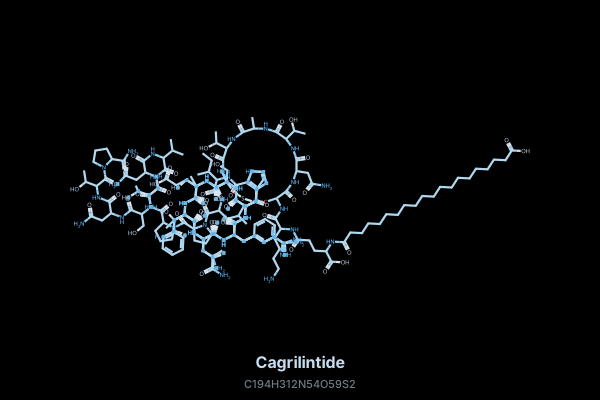
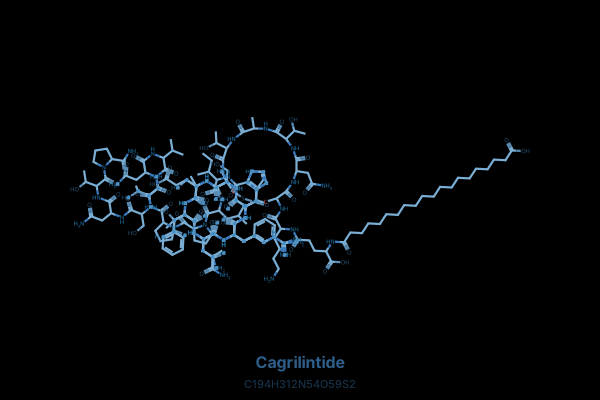
Chemical structure of cagrilintide, the comparator amylin analogue.

Why verification is the whole game for a frontier compound

With no established supply history, every eloralintide vial in circulation is only as real as its testing. The risk here is not subtle degradation, it is wholesale substitution with cheaper amylin-adjacent material, and only mass-spectrometry identity testing catches that.

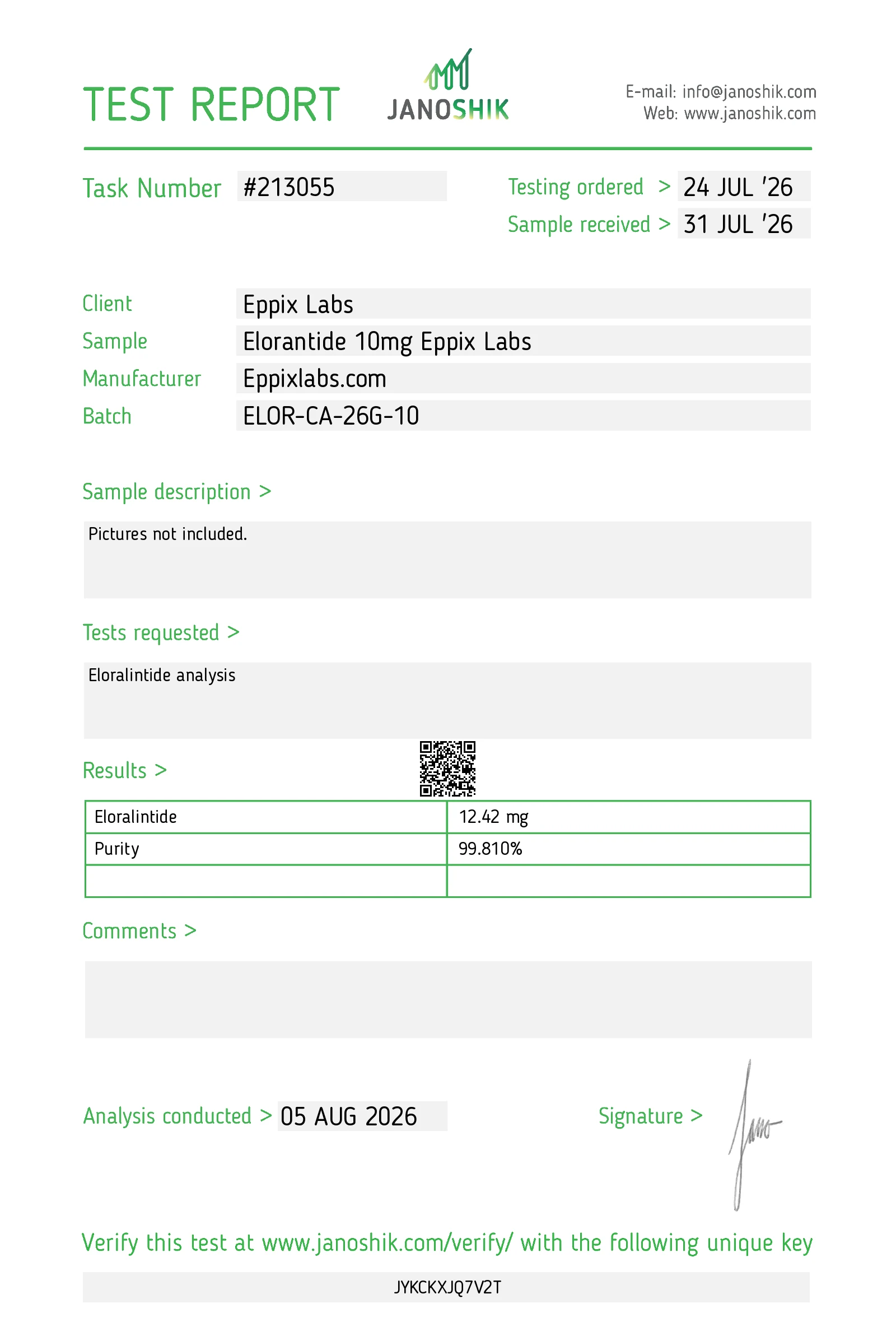
The Eppix standard applies unchanged: every lot tested by Janoshik Analytical, with MS identity, HPLC purity and measured mass, the certificate published before sale and verifiable on the laboratory's own database. The walkthrough for reading one is at how to verify a peptide COA.

Published Certificate
Certificate of analysis for Buy Eloralintide Canada | Amylin Agonist 10mg, batch ELOR-CA-26G-10, 99.810% purity, 12.42 mg measured content
Batch
ELOR-CA-26G-10
Purity (HPLC)
99.810%
Measured content
12.42 mglabelled 10 mg
Laboratory
Janoshik
Published certificate for the current eloralintide lot, read live from the batch record.

Sourcing in Canada

Domestic fulfilment is by Canada Post Xpresspost, typically one to two days nationwide, free over $200, with an Interac e-Transfer discount and mix-and-match pricing at 5 and 10 vials. Current availability is shown on the card below and on the product page, which is where stock should be read from rather than from an article.

The sibling guide is buy cagrilintide in Canada.

Frequently Asked

Is eloralintide legal in Canada?

It is not a scheduled substance and may be sold and held for laboratory research. It is not approved for human use in any jurisdiction. This is not legal advice.

How is eloralintide different from cagrilintide?

Both act on amylin receptors. Eloralintide is engineered for receptor selectivity, cagrilintide for long-acting kinetics with a broader profile, and their development programmes at Lilly and Novo Nordisk are independent.

Is there human data on eloralintide?

Yes, and it is peer-reviewed: a phase 1 proof-of-concept study and a 48-week phase 2 trial published in the Lancet in December 2025. There is no phase 3 dataset and no approval anywhere.

Why would a researcher choose it over established amylin analogues?

Selectivity. Isolating amylin-receptor signaling without confounding activity at related receptors is the tool-compound use case, and it is what the molecule was designed for.

What should an eloralintide certificate show?

Batch number matching the vial, the named testing laboratory, test date, MS identity confirmation (critical for a compound this new), HPLC purity and measured mass, verifiable at the testing laboratory through the certificate's own key.

Why is the molecular formula not listed?

It has not been placed in the public domain. Stating that is more useful than publishing a number that cannot be checked. The CAS registry number is public and is listed above.

How is eloralintide stored?

Lyophilized: cool, dry, dark, at -20 °C. Reconstituted: refrigerated, per your protocol. See the peptide storage guide.

References

  1. Billings, L.K. et al. (2025). Eloralintide, a selective amylin receptor agonist for the treatment of obesity: a 48-week phase 2, multicentre, double-blind, randomised, placebo-controlled trial. Lancet. PMID 41207310
  2. Bhattachar, S. et al. (2026). Eloralintide, a selective, long-acting amylin receptor agonist for treatment of obesity: phase 1 proof of concept. Diabetes Obes Metab. PMID 41559929
  3. Briere, D.A. et al. (2025). Eloralintide (LY3841136), a novel amylin receptor agonist for the treatment of obesity: from discovery to clinical proof of concept. Mol Metab. PMID 41109426
  4. Hay, D.L. et al. (2015). Amylin: pharmacology, physiology, and clinical potential. Pharmacol Rev 67(3):564-600. PMID 26071095

Research Use Only

This article summarizes published preclinical research literature. Compounds referenced are supplied by Eppix Labs strictly as research materials for laboratory investigation within Canada. They are not approved by Health Canada for human or veterinary use, and nothing on this page should be interpreted as medical advice or guidance on human or animal administration.