

 Sale
SaleMetabolic & GLP-1
Retatrutide
Next-generation GLP receptor agonist studied for metabolic signaling and nutrient partitioning pathways
RETA-CA-26E-0199.637%
11.76 mg / 10 mg
$60.00$70.00CAD
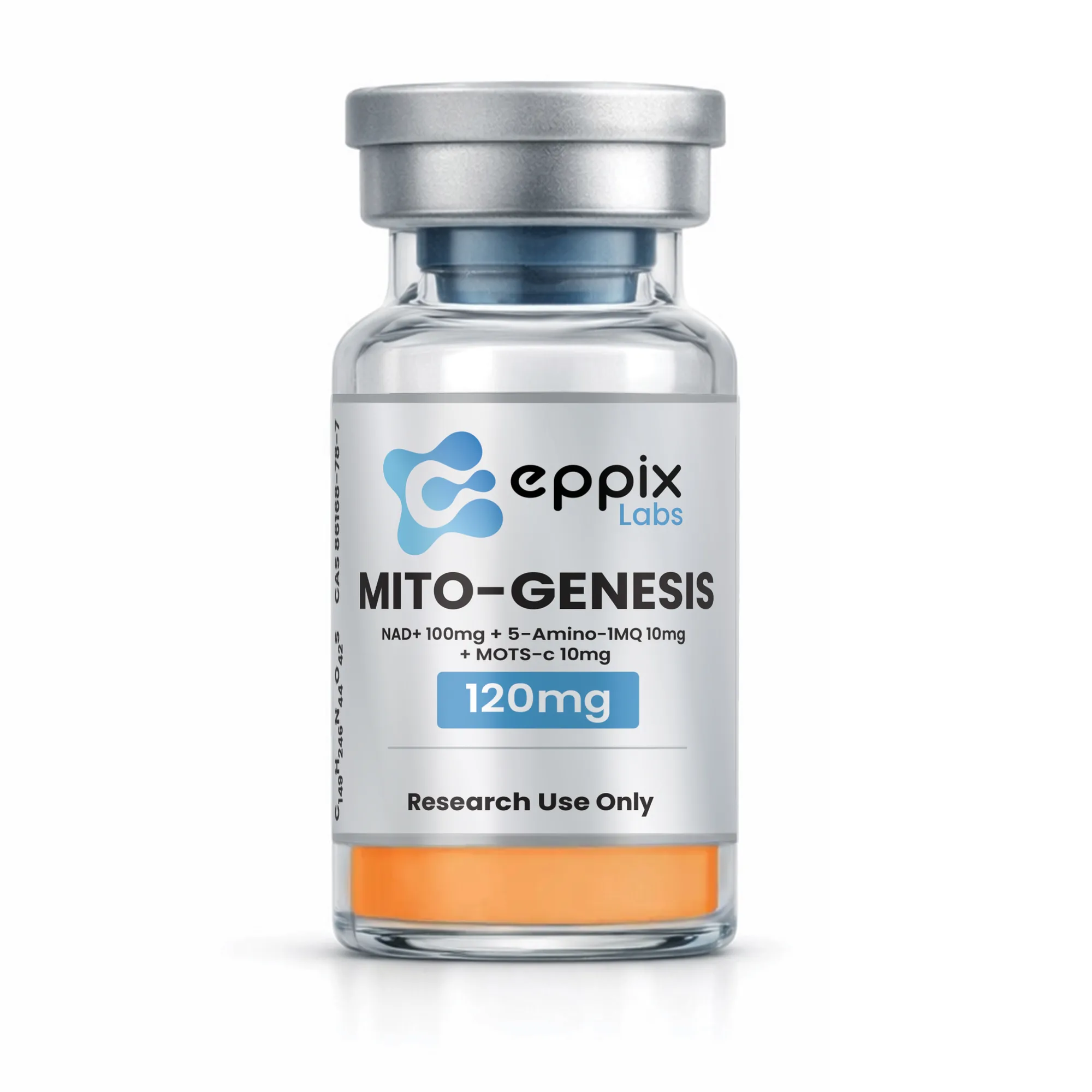
Mito-Genesis Blend Canada | NAD+ 5A1MQ MOTS-c
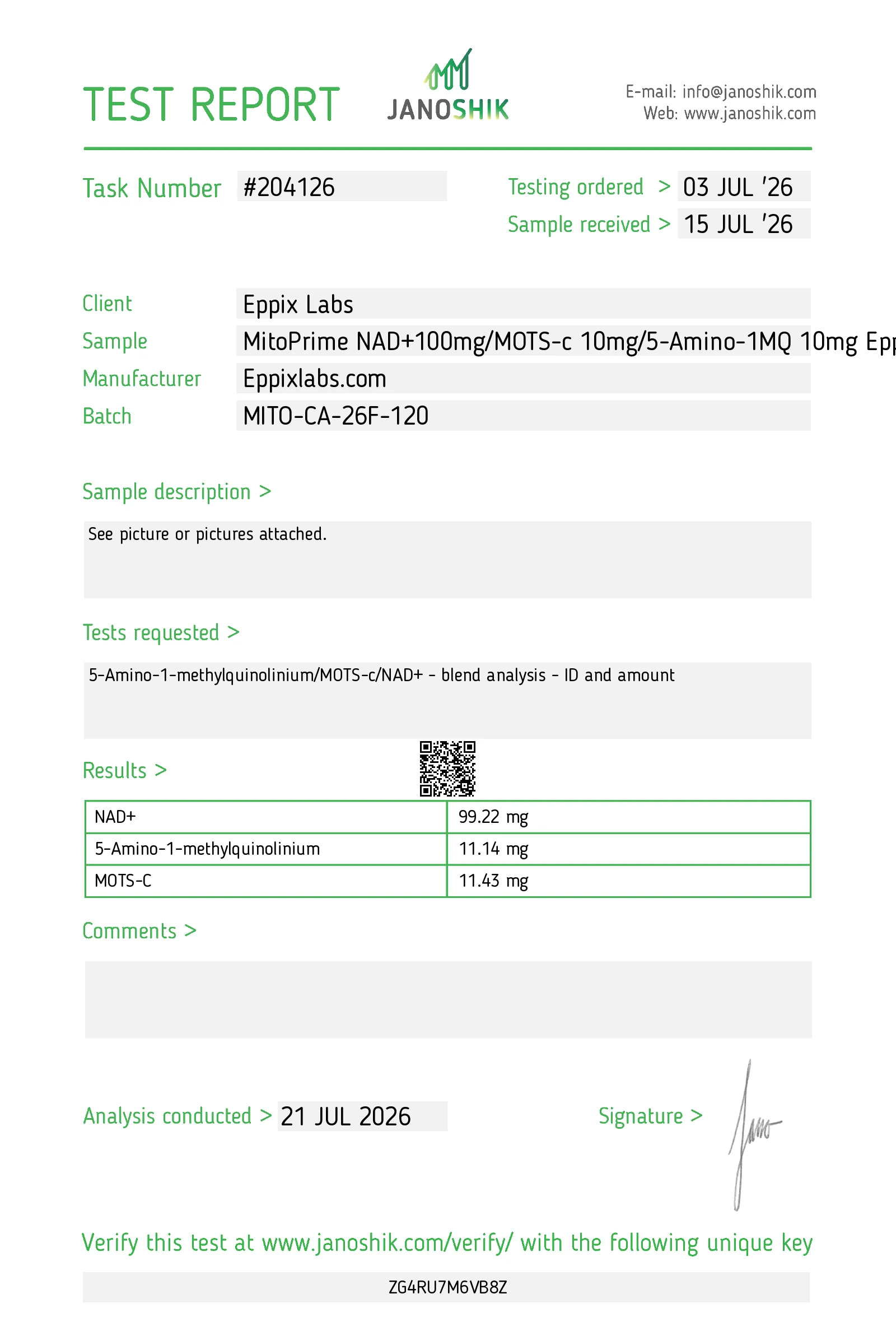
Janoshik
Batch MITO-CA-26F-120
Mitochondrial Blend
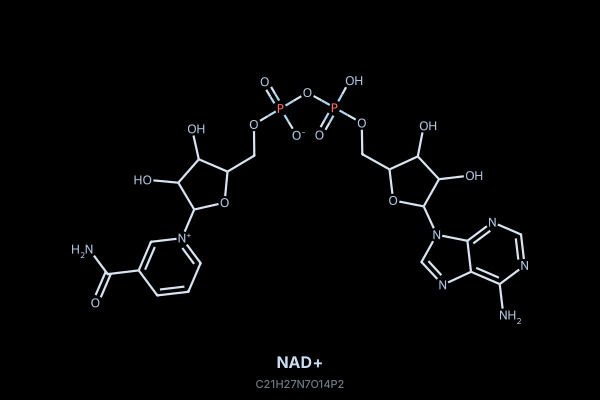
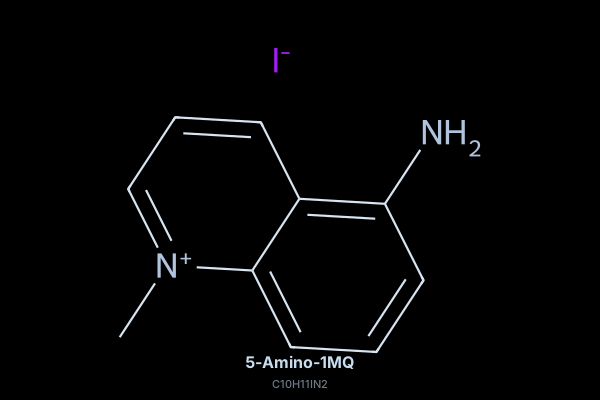
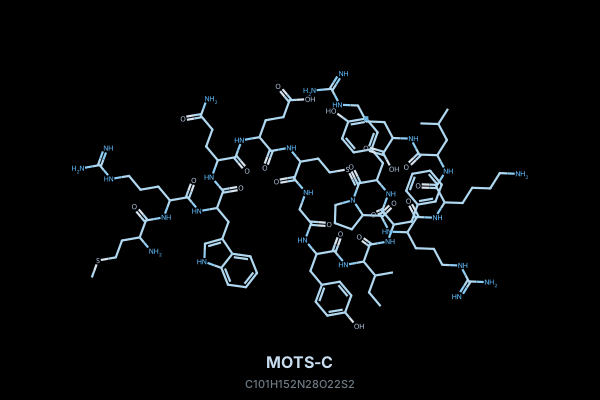
Also known as NAD+ 100mg + 5-Amino-1MQ 10mg + MOTS-c 10mg
Mito-Genesis is a research blend supplying NAD+, 5-Amino-1MQ, and MOTS-c in a single vial.
Mix & Match
1 vial — no vial discount yet.
Add 2 more vials for 5% off.
After that, 10% at 5 vials, 20% at 10 vials.
This product is intended strictly for laboratory research use within Canada. It is not approved by Health Canada for the diagnosis, treatment, cure, or prevention of any disease. Not for human or veterinary use.
By purchasing, you confirm the material will be used solely for lawful research purposes in accordance with applicable Canadian regulations.
Mito-Genesis is a research blend supplying NAD+, 5-Amino-1MQ, and MOTS-c in a single vial.
Each component is studied separately in mitochondrial and metabolic research; the blend itself has no combined published literature.
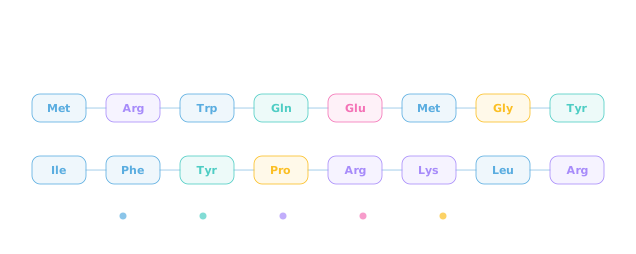
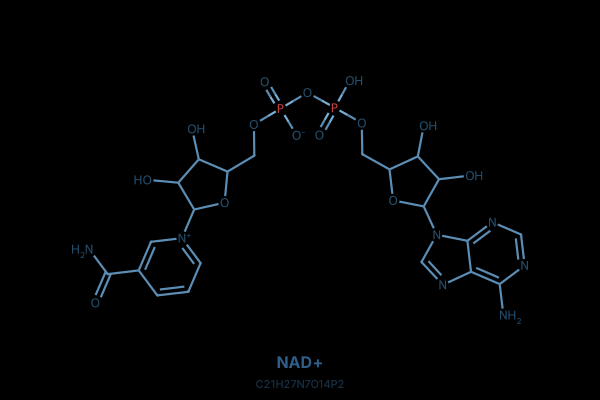
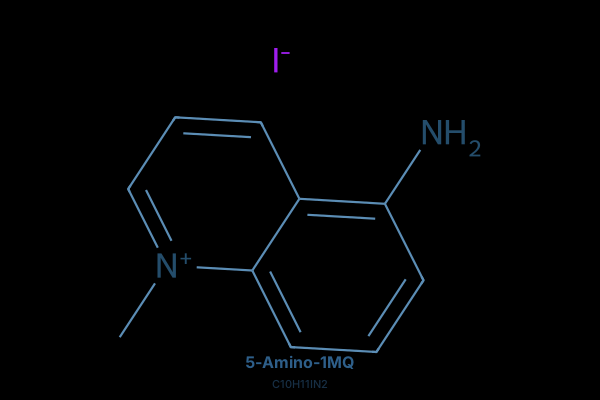
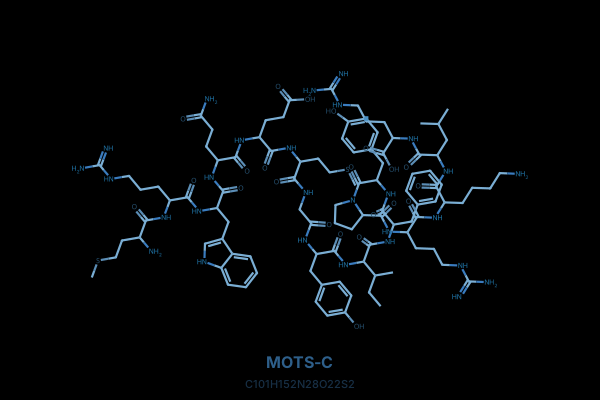
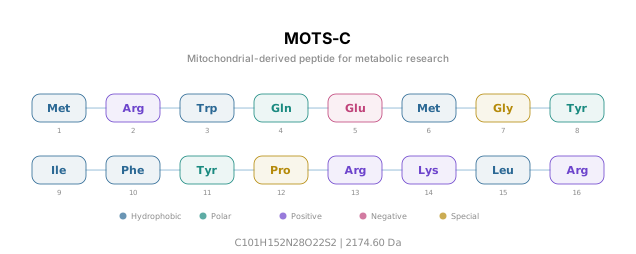
Mito-Genesis combines three compounds associated with mitochondrial and metabolic research. NAD+ is a central redox cofactor whose decline is a recurring theme in cellular-ageing work. 5-Amino-1MQ is a small-molecule NNMT inhibitor studied for effects on nicotinamide salvage. MOTS-c is a mitochondrial-derived peptide characterized for metabolic homeostasis and nuclear gene regulation under metabolic stress.
The combination is a formulation choice, not a studied entity. References below are drawn from the component literature.
Each component entered research independently: NAD+ through decades of redox-biology work, 5-Amino-1MQ through NNMT inhibitor screening, and MOTS-c through the discovery of mitochondrial-derived peptides in the 2010s.
Blending them into a single research vial is a supplier formulation with no separate development history.
Research relevant to Mito-Genesis is the sum of its components: mitochondrial-derived peptide signaling, NAD+ redox metabolism, and NNMT inhibition. No study has evaluated this specific three-component combination.
4 of the 4 areas below are addressed directly by a paper cited on this page.
Addressed on this page by Lee 2015, Kim 2017. Each is linked to its source record in the references below, so what was measured — and in what system — can be read rather than taken on trust.
Addressed on this page by Ying 2006. Each is linked to its source record in the references below, so what was measured — and in what system — can be read rather than taken on trust.
Addressed on this page by Cantó 2012, Neelakantan 2017. The work appeared in J Med Chem. Each is linked to its source record in the references below, so what was measured — and in what system — can be read rather than taken on trust.
Addressed on this page by Lee 2015. Each is linked to its source record in the references below, so what was measured — and in what system — can be read rather than taken on trust.
The references section of this page cites 5 primary papers published between 2006 and 2017 — a limited but non-trivial record. Every citation is linked to its PubMed or DOI record so it can be read rather than taken on trust, and the summaries above describe what those papers report rather than what the compound is claimed to do.
Research compounds attract claims that outrun their evidence. Below are the ones most often encountered for Mito-Genesis Blend, set against what the papers cited on this page actually report. Where the record is thin or contested, that is stated rather than smoothed over.
Mito-Genesis Blend is commonly described online in connection with weight loss, appetite suppression and fat reduction. In the research literature the same compound is filed under mitochondrial-derived peptide signaling (MOTS-c), NAD+ redox and cellular-ageing models and NNMT inhibition and nicotinamide salvage.
The 5 papers cited on this page, published between 2006 and 2017 describe laboratory and animal work. None reports a controlled trial in humans. Findings in cell culture or in a rodent model describe what happened in that system; they do not establish that the same occurs in humans, and this compound is not approved for human use.
Nothing above is a statement of what this material does. It is a summary of what has been published and what has not. Eppix Labs supplies research materials only and provides no dosing, administration or protocol guidance.
The lot code printed on the vial matches the code on the certificate for Mito-Genesis Blend. Matching the two is what confirms the unit in hand came from the batch that was tested — a certificate not tied to a lot code proves nothing about any particular unit.
Researchers who buy Mito-Genesis Blend in Canada through Eppix Labs receive the lot described by the certificate above: the code printed on the vial label is the code on the certificate, and both are searchable on the batch verification page.
Mito-Genesis Blend is a co-lyophilized blend — more than one compound freeze-dried together in a single vial. Handling follows the least stable component rather than an average, and the same is true of storage: the constraint that binds is whichever compound in the vial is most sensitive.
Reconstituting a blend does not separate its components, so a blend cannot be split into its parts after the fact. That is why per-component content verification matters more here than a single blended purity figure — the ratio inside the vial is fixed at manufacture and cannot be corrected downstream.
Vials may appear empty on arrival. Lyophilized material collects at the base of the vial and is often not visible until the vial is inspected under direct light.
Reconstitution materials are sourced separately. The reconstitution calculator on this site works out concentrations for a given volume, but it is an arithmetic tool for laboratory record-keeping and not a protocol.
No. Eppix Labs products are supplied exclusively for laboratory research. We do not provide dosing, administration, or usage guidance.
Each unit contains the labeled quantity of Mito-Genesis. Independent third-party analysis verifies purity, identity, and net content per batch.
The unit contains only the research compound. Any laboratory materials required for reconstitution or experimental procedures must be sourced separately.
Duration depends entirely on research design, storage conditions, and laboratory protocol.
The mitochondrial-derived peptide MOTS-c promotes metabolic homeostasis and reduces obesity and insulin resistance.
PubMedThe NAD(+) precursor nicotinamide riboside enhances oxidative metabolism and protects against high-fat diet-induced obesity.
PubMedStructure-Activity Relationship for Small Molecule Inhibitors of Nicotinamide N-Methyltransferase. J Med Chem 60(13):5015–5028.
PubMedRelated
SaleMetabolic & GLP-1
Next-generation GLP receptor agonist studied for metabolic signaling and nutrient partitioning pathways
RETA-CA-26E-0199.637%
11.76 mg / 10 mg
$60.00$70.00CAD
 Sale
SaleMetabolic & GLP-1
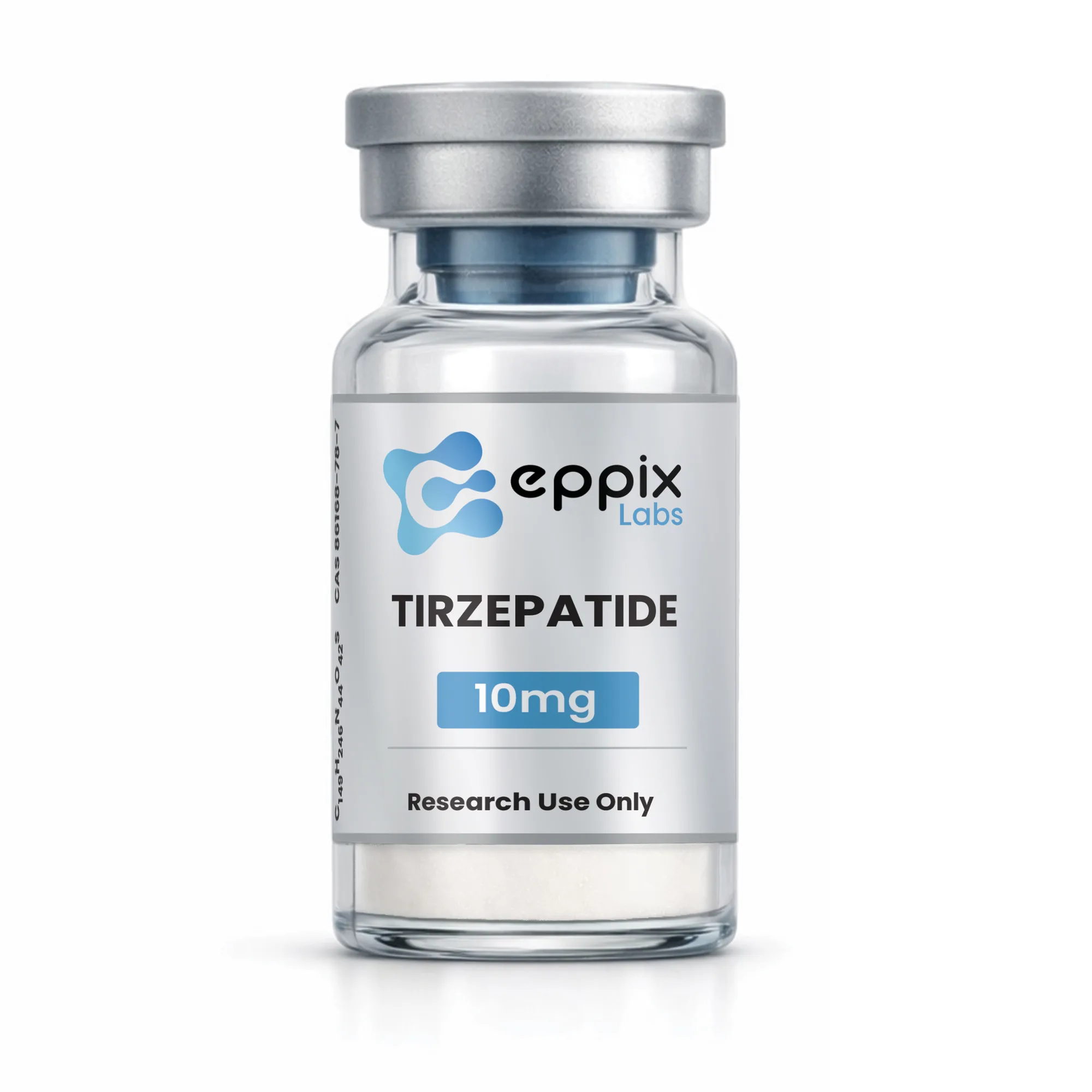
Dual incretin receptor agonist studied for glucose regulation, metabolic signaling, and weight pathway research
TIRZ-CA-26G-1099.634%
11.42 mg / 10 mg
$35.00$40.00CAD
Metabolic & GLP-1
Studied in metabolic research for its effects on glucose regulation, appetite signaling, and energy balance.
10 mgSEMA-CA-26F-1099.504%
11.27 mg / 10 mg
$70.00CAD
Metabolic & GLP-1
This product is supplied as eloralintide (LY3841136), a long-acting, selective amylin receptor agonist studied in research on metabolic and body-weight regulation.
10 mgELOR-CA-26G-1099.810%
12.42 mg / 10 mg
$150.00CAD