Research Use OnlyAll materials supplied for laboratory research within Canada
Formula
C32H55N9O10
Mol. weight
725.8
Form
Lyophilized powder
Low on StockCapsule
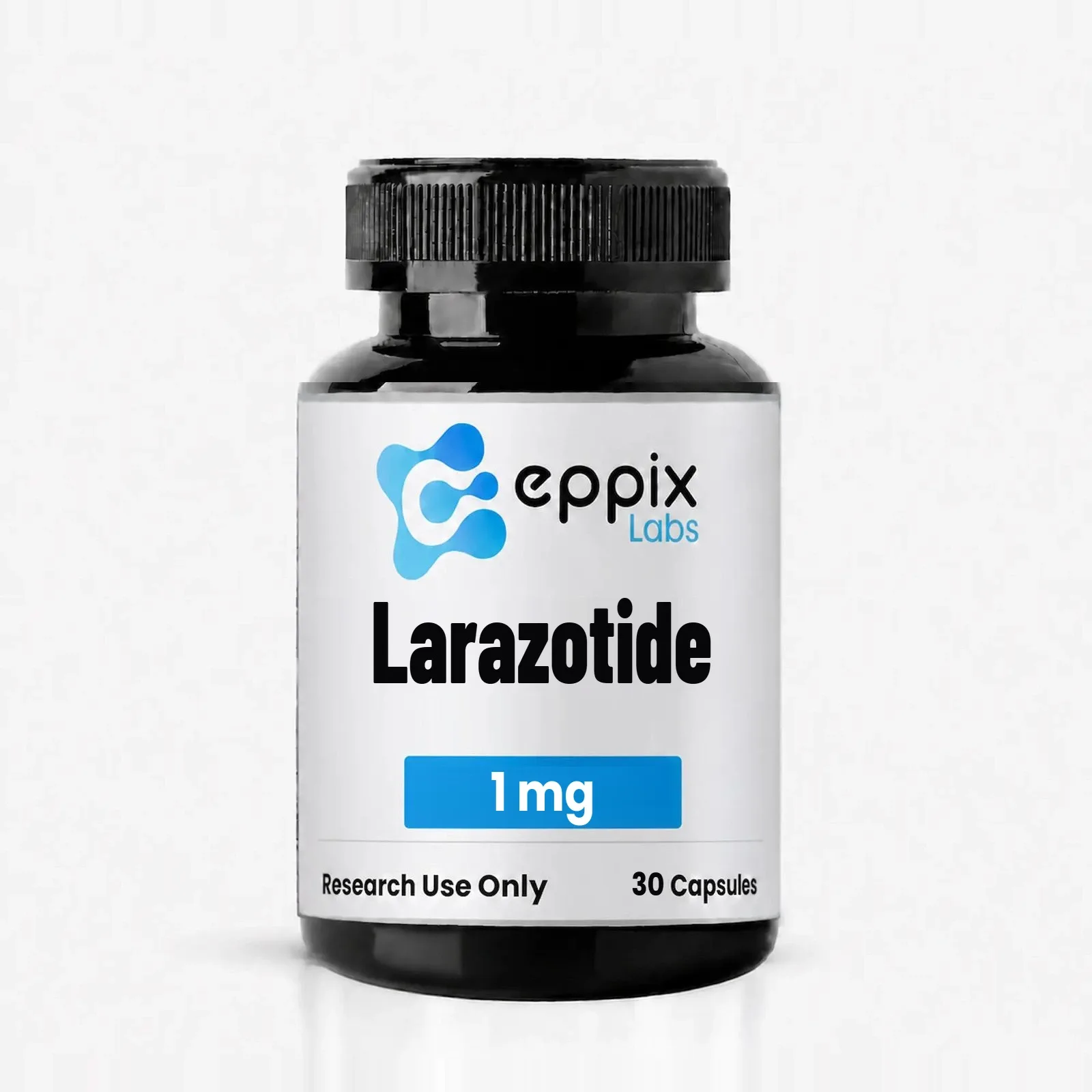
Larazotide 1mg
Larazotide 1mg Canada — Lyophilized Vials
Tight Junction Regulator Peptide
Larazotide is a synthetic octapeptide studied as a regulator of intestinal epithelial tight junctions. It is supplied as a lyophilized compound for laboratory research and is frequently referred to in the literature by its development code AT-1001 and as larazotide acetate.
$99.00CAD
Discount and referral codes apply at checkout. Sales, Mix & Match and payment-method discounts don't.
Purity VerifiedLab TestedSecure
Research Use Only
This product is intended strictly for laboratory research use within Canada. It is not approved by Health Canada for the diagnosis, treatment, cure, or prevention of any disease. Not for human or veterinary use.
By purchasing, you confirm the material will be used solely for lawful research purposes in accordance with applicable Canadian regulations.
Larazotide is a synthetic octapeptide studied as a regulator of intestinal epithelial tight junctions. It is supplied as a lyophilized compound for laboratory research and is frequently referred to in the literature by its development code AT-1001 and as larazotide acetate.
Published work has examined larazotide in cell culture models of epithelial barrier assembly, in animal models of intestinal injury and permeability, and in clinical trial programs focused on coeliac disease and on multisystem inflammatory syndrome in children.
Purity
Third-party tested for purity, ID, quantity.
Coming Soon
The certificate of analysis for this lot is being finalised and will be published here as soon as the lab returns it.
Larazotide is described in the literature as a zonulin pathway antagonist. Experimental work has characterised it as acting at the apical surface of intestinal epithelial cells, where it has been reported to promote tight junction assembly and to interfere with zonulin-associated signaling that leads to junctional disassembly. Cell culture studies have examined its effects on tight junction protein localisation, actin cytoskeletal organisation, and transepithelial resistance, and later work has extended the same framework to endothelial tight junctions in vascular tissue.
Research endpoints evaluated across the published record include epithelial and endothelial barrier integrity, paracellular permeability measures, recovery of ischemia- and anoxia/reoxygenation-injured intestinal mucosa, bacterial translocation in rodent injury models, and markers of systemic inflammation. Clinical investigation has centred on coeliac disease, where randomised trials and a systematic review have assessed symptom and permeability endpoints, and on a trial in children with post-COVID multisystem inflammatory syndrome that examined antigen clearance and recovery measures. Formulation research has also used larazotide as the released agent in hydrogel delivery systems evaluated in colitis models.
History
Larazotide originated from work on the zonula occludens toxin of Vibrio cholerae and the endogenous tight junction modulator zonulin. The peptide, designated AT-1001, was developed as an antagonist of that pathway, and early characterisation studies examined its ability to promote tight junction assembly in epithelial cell monolayers.
The research record subsequently expanded in two directions. One line of work carried the peptide into clinical trials in coeliac disease, generating randomised controlled data later pooled in a systematic review and discussed in subsequent reviews of barrier restoration strategies. A second line pursued preclinical barrier models: ischemic and anoxia/reoxygenation injury in intestinal mucosa, acute pancreatitis and bacterial translocation in rats, arthritis onset linked to barrier function, endothelial tight junctions in aortic disease, and sustained-release formulations in colitis. A case series and a later trial in multisystem inflammatory syndrome in children added a separate clinical strand.
Key Research Areas
Larazotide appears in research frameworks concerned with the regulation of paracellular permeability. In vitro work addresses tight junction assembly and barrier function in epithelial monolayers; animal work addresses intestinal injury, permeability and bacterial translocation, and extends to endothelial junctions outside the gut; clinical work has centred on coeliac disease and on multisystem inflammatory syndrome in children. Formulation studies have evaluated the peptide as a payload in sustained-release delivery systems in experimental colitis.
5 of the 5 areas below are addressed directly by a paper cited on this page.
Tight junction assembly and epithelial barrier models
Addressed on this page by Gopalakrishnan 2012, Slifer 2021, Slifer 2021. Each is linked to its source record in the references below, so what was measured — and in what system — can be read rather than taken on trust.
Slifer, ZM. et al. (2021) — Larazotide acetate: a pharmacological peptide approach to tight junction regulation
Slifer, ZM. et al. (2021) — Larazotide acetate induces recovery of ischemia-injured porcine jejunum via repair of tight junctions
Zonulin pathway and intestinal permeability research
Addressed on this page by Tajik 2020. Each is linked to its source record in the references below, so what was measured — and in what system — can be read rather than taken on trust.
Tajik, N. et al. (2020) — Targeting zonulin and intestinal epithelial barrier function to prevent onset of arthritis
Intestinal ischemia and reoxygenation injury models
Addressed on this page by Slifer 2021, Tajik 2020. Each is linked to its source record in the references below, so what was measured — and in what system — can be read rather than taken on trust.
Slifer, ZM. et al. (2021) — Larazotide acetate induces recovery of ischemia-injured porcine jejunum via repair of tight junctions
Tajik, N. et al. (2020) — Targeting zonulin and intestinal epithelial barrier function to prevent onset of arthritis
Coeliac disease clinical research frameworks
Addressed on this page by Hoilat 2022. Each is linked to its source record in the references below, so what was measured — and in what system — can be read rather than taken on trust.
Hoilat, GJ. et al. (2022) — Larazotide acetate for treatment of celiac disease: A systematic review and meta-analysis of randomized controlled trials
Endothelial junction and systemic inflammation studies
Addressed on this page by Slifer 2021, Gopalakrishnan 2012, Slifer 2021. Each is linked to its source record in the references below, so what was measured — and in what system — can be read rather than taken on trust.
Slifer, ZM. et al. (2021) — Larazotide acetate: a pharmacological peptide approach to tight junction regulation
Slifer, ZM. et al. (2021) — Larazotide acetate induces recovery of ischemia-injured porcine jejunum via repair of tight junctions
The references section of this page cites 6 primary papers published between 2012 and 2025 — a limited but non-trivial record. Every citation is linked to its PubMed or DOI record so it can be read rather than taken on trust, and the summaries above describe what those papers report rather than what the compound is claimed to do.
Larazotide 1mg is frequently listed as a peptide by suppliers in this market. It is not one. The structure published on this page is the compound's actual chemistry, and research on it should be read against its own class rather than against peptide literature.
Research compounds attract claims that outrun their evidence. Below are the ones most often encountered for Larazotide 1mg, set against what the papers cited on this page actually report. Where the record is thin or contested, that is stated rather than smoothed over.
Human trial data exists
Larazotide 1mg is commonly described online in connection with faster healing from injury and improved recovery. In the research literature the same compound is filed under tight junction assembly and epithelial barrier models, zonulin pathway and intestinal permeability research and intestinal ischemia and reoxygenation injury models.
Of the 6 papers cited on this page, published between 2012 and 2025, 1 reports work in human participants — Hoilat 2022. Human data for a molecule is not the same as evidence for material supplied as a research compound: published trials use pharmaceutical-grade product under medical supervision at defined doses. What is established for the material sold here is its measured purity and content per lot.
Nothing above is a statement of what this material does. It is a summary of what has been published and what has not. Eppix Labs supplies research materials only and provides no dosing, administration or protocol guidance.
Every lot of Larazotide 1mg is independently assayed before it is released, and the certificate for the lot shipped is published rather than summarised. Where a certificate for a current lot is not yet posted, the lot has not yet been released against it.
Researchers who buy Larazotide 1mg in Canada through Eppix Labs receive a batch-labelled vial whose certificate is published against that lot code, so the material can be matched to its analysis rather than to a generic specification.
−20 °C long-term; stable at room temperature in transit
After reconstitution
2–8 °C
Light
Protect from UV and direct light
Freeze-thaw
Avoid repeated cycles
Vehicle
Solvent selection depends on the compound; consult the published literature
Format
Lyophilized powder
Larazotide 1mg is supplied as lyophilized powder. It is not a peptide, and solvent behaviour follows from its own chemistry rather than from the aqueous-vehicle conventions that apply to peptide material — the published literature for this compound is the reference for solvent selection, not a general peptide protocol.
Dry storage below freezing and protection from light are the general controls. As with any lyophilized material, the powder frequently sits as a thin film at the base of the vial and is easy to mistake for an empty vial before inspection.
Vials may appear empty on arrival. Lyophilized material collects at the base of the vial and is often not visible until the vial is inspected under direct light.
1 × sealed glass vial (1mg per capsule / Single Bottle - Pack of 30), batch-labelled
Batch documentation for the lot shipped, once its certificate is published
Discreet outer packaging with no product names on the exterior
Canada Post Xpresspost, tracked, typically 1–2 business days from Canadian stock
Not included
Bacteriostatic water or any other reconstitution vehicle
Syringes, needles or filters
Dosing, administration or protocol guidance of any kind
Reconstitution materials are sourced separately. The reconstitution calculator on this site works out concentrations for a given volume, but it is an arithmetic tool for laboratory record-keeping and not a protocol.
No. Eppix Labs products are supplied exclusively for laboratory research. We do not provide dosing, administration, or usage guidance.
Each vial contains 1mg of lyophilized larazotide. Independent third-party analysis verifies purity, identity, and net content per batch.
The vial contains only the lyophilized peptide. Any laboratory materials required for reconstitution or experimental procedures must be sourced separately.
Duration depends entirely on research design, storage conditions, and laboratory protocol.
Slifer, ZM. et al.(2021)
Larazotide acetate: a pharmacological peptide approach to tight junction regulation
PDE5 Inhibitor Research Compound
Tadalafil is a small-molecule phosphodiesterase type 5 (PDE5) inhibitor supplied in capsule form for laboratory research. It is handled as a reference compound in controlled experimental and analytical settings.
Oral Non-Peptide GLP-1 Receptor Agonist
Orforglipron is an orally available, non-peptide small molecule characterised as an agonist at the glucagon-like peptide-1 (GLP-1) receptor. It is supplied here in capsule form for laboratory research within controlled experimental environments.
Phenothiazine Dye Compound
Methylene blue is a synthetic phenothiazine dye used across laboratory and procedural settings as a staining and tracing agent. It is supplied here in capsule form strictly as a research material.
Copper Tripeptide Complex
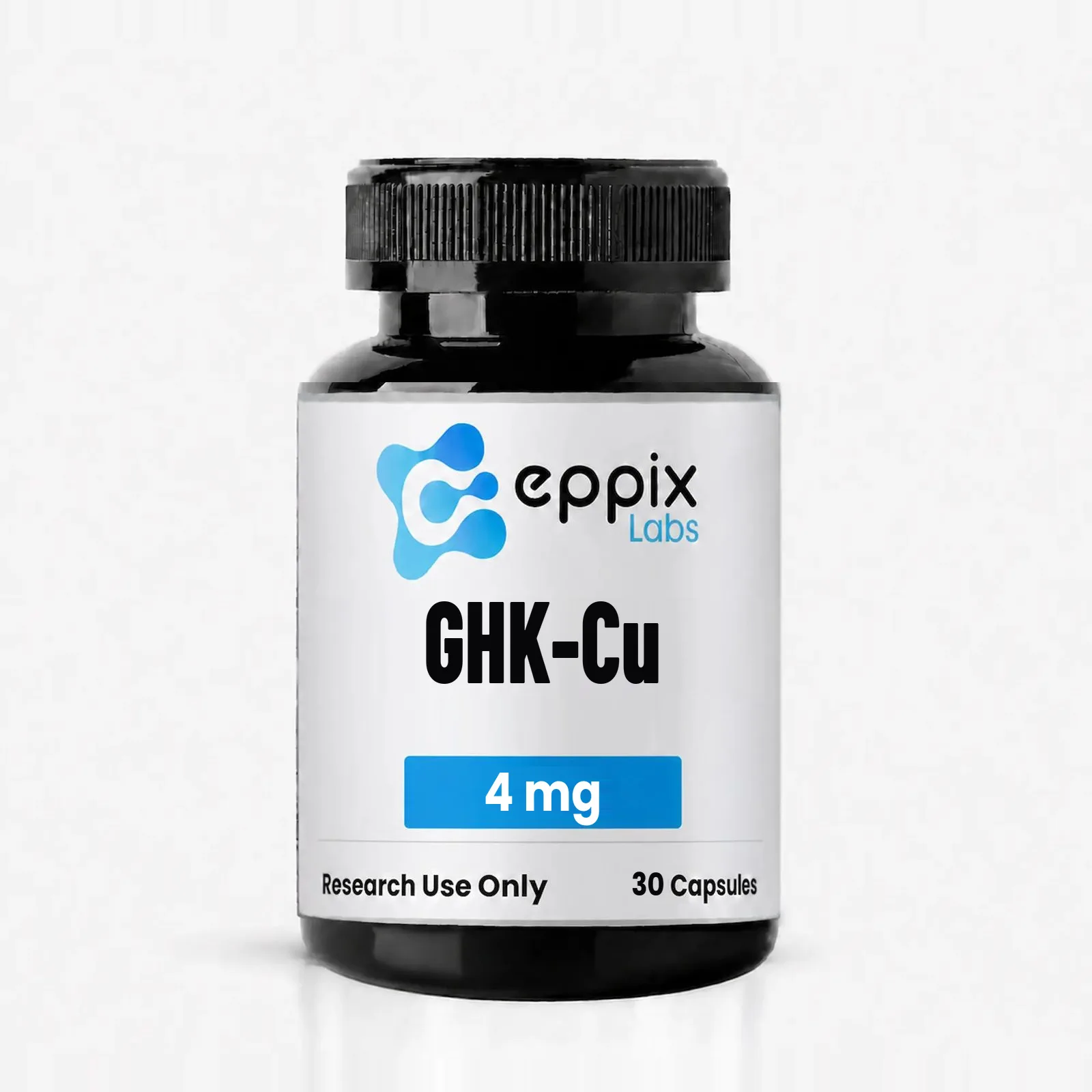
GHK-Cu is a complex of the tripeptide glycyl-L-histidyl-L-lysine with copper. This listing is for an encapsulated format supplied strictly for laboratory research.
GHKC-CA-26I-01
$29.95CAD
Support
Need help?
Have questions about batch verification, documentation, or research specifications? Our team is available to assist with product and compliance inquiries.